- Start from LTX-2.5 Pre-Trained, the raw non-SFT base published for robotics, AV, and industrial digital twins. Fine-tuning the production checkpoint means fighting a model already tuned for cinematic output.
- Condition on text, images, reference video, audio, and keyframes to hold a scene fixed and vary one factor at a time. That control is what turns generation into a dataset rather than a pile of clips.
- Synthetic data supplements a real dataset, it does not replace one. Mix in real reference footage, fine-tune on real target-domain examples, and validate on held-out real data.
Synthetic data generation with world models means using a model that understands and generates physical reality to produce labeled training footage for perception systems, instead of collecting and annotating real-world data by hand.
For robotics, autonomous vehicles, and computer vision teams, this solves the hardest part of the pipeline: getting enough varied, correctly labeled examples of rare or dangerous events.
A world model can generate those scenarios on demand, with full control over conditions that are expensive or unsafe to capture in the real world.
This guide explains what synthetic data is, how world models generate it, which LTX-2.5 checkpoint you should actually start from, and where it applies across the three verticals.
What is synthetic data?
Synthetic data is machine-generated content, used to train models when real labeled data is scarce, expensive, or unsafe to collect.
In perception AI that means generated video and images of scenes a model needs to recognize: a pedestrian stepping off a curb at dusk, a warehouse robot encountering a spill, a camera detecting a defect on a production line.
Because the data is generated, its labels are known at creation time, which removes the manual annotation step that dominates the cost of most computer vision datasets.
The value is coverage. Real datasets over-represent common cases and under-represent the rare ones, and the rare ones are exactly where perception systems fail. Synthetic generation lets a team produce thousands of variations of an edge case, balancing a dataset that reality delivers unevenly.
Start from the right checkpoint
This is the decision that matters most, and it is easy to get wrong.
LTX-2.5 ships two ways. The main release is supervised fine-tuned and post-trained for general-purpose video and audio generation. LTX-2.5 Pre-Trained is the raw, non-SFT base from before that stage.
The pretrained checkpoint is the one built for this work. LTX documents its intended uses as egocentric robotics and manipulation, action-conditioned world prediction, autonomous vehicle and drone data, and industrial digital twins, all through the open-source LTX Trainer.
Fine-tuning the production checkpoint instead means fighting a model already locked into cinematic output. Same 22B foundation, different starting point, materially different results.
One honest caveat, stated on LTX's own world model page: the pretrained checkpoint is a foundation to build from, not an out-of-the-box robotics or autonomous-driving system. It requires domain-specific fine-tuning and evaluation.
Worth settling early: using generated output to train another model has licensing implications that depend on your revenue and your specific use case, so it needs its own discovery pass. Get in touch for specifics before you build a pipeline on it.
How do world models generate synthetic data?
World models generate synthetic data by modeling the joint distribution of a scene over time, then sampling new, controllable variations of it.
Unlike a tool that stitches together clips, a world model captures dependencies between motion, lighting, and physics, so the output stays coherent as conditions change.
LTX-2.5 is a 22-billion-parameter asymmetric dual-stream diffusion transformer that generates video with synchronized audio, and the open-source pipelines accept text prompts, image conditioning, reference videos, audio, and keyframe guidance as inputs. The conditional generative model page covers combining those inputs.
Controllable conditioning is what turns generation into a data pipeline. Because you can condition on text, a reference image, or an existing video, you can hold a scene fixed and vary one dimension at a time: change the weather, the time of day, the camera angle, or the density of a crowd, while the rest stays consistent.
Video-native generation matters here too. A model that produces temporally consistent video rather than isolated frames gives perception systems the motion cues they actually train on.
Robotics: training for rare events
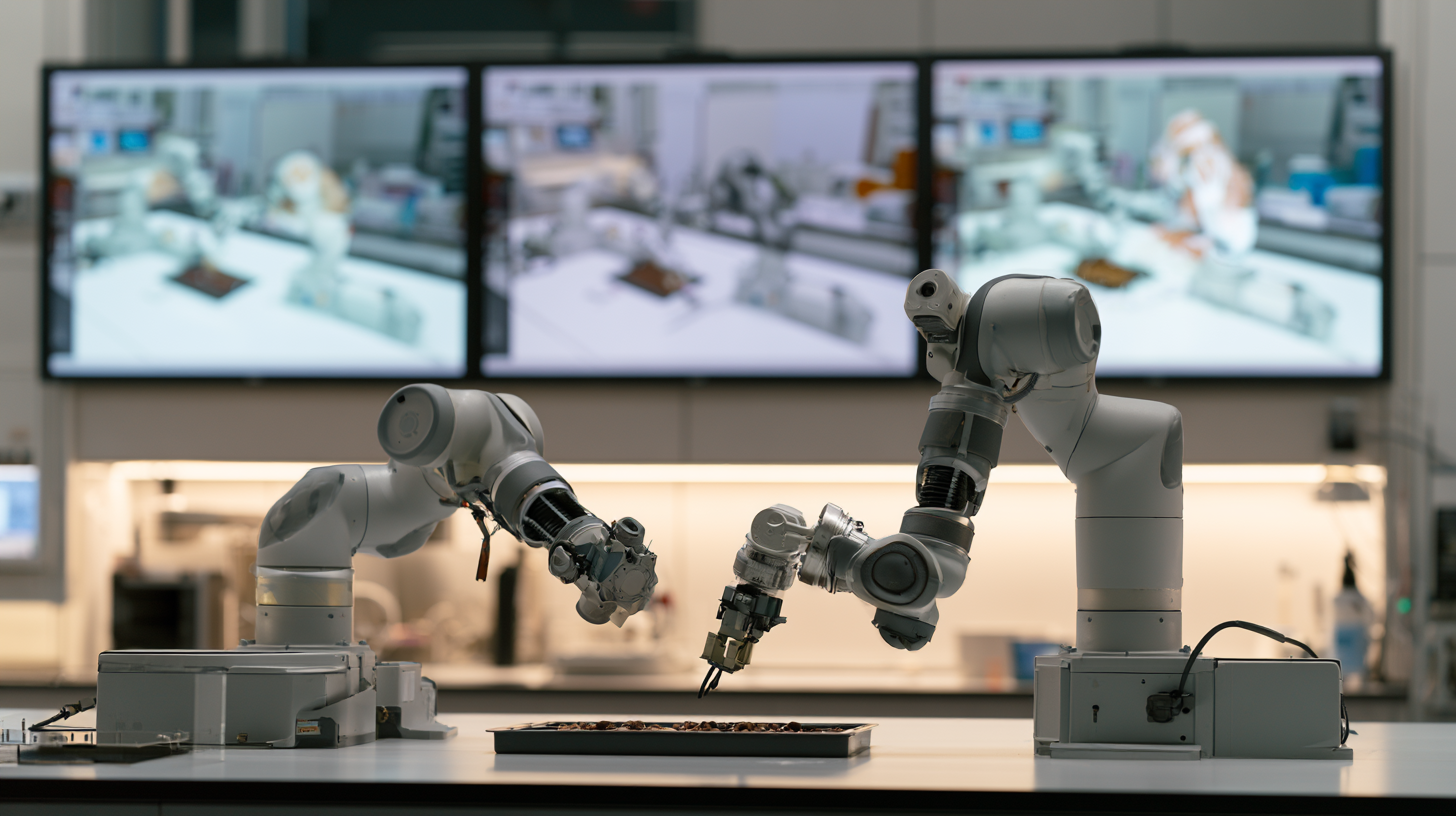
Robotics teams use synthetic data to train perception and manipulation policies on events too rare or too costly to stage repeatedly.
A robot arm learning to handle a dropped object, or a mobile robot navigating an unexpected obstacle, needs thousands of examples that a physical lab produces slowly. A world model generates those interactions with controlled variation in object position, lighting, and clutter.
The documented approach is to fine-tune the pretrained checkpoint on egocentric footage and action data, modeling how a robot's actions change what it perceives next. Domain-specific action or state data, meaning robot trajectories, sensor logs, and simulation states, is what the trainer expects.
Markov Robotics is one team building on this, using LTX to develop how physical systems perceive and move through the world. The robotics and physical AI page covers the wider set of deployments.
Because you self-host, the data stays in your environment, which is the practical reason IP-sensitive facilities can use generation at all.
Autonomous vehicles: covering the edge cases
Autonomous vehicle teams use synthetic data for the edge cases that dominate safety validation but rarely appear in collected fleet data: a child chasing a ball into a street, sudden fog, a stalled vehicle around a blind curve.
Generating these with a world model produces the volume of rare-event footage that on-road collection would take years to gather, with control over weather, lighting, and sensor placement, and without putting a vehicle at risk.
Perception here depends on consistent conditions across a whole clip, which is where a temporally coherent model beats frame-by-frame generation.
Condition on a base scene and vary one factor to build matched sets that isolate a single variable. That is how you measure whether a model actually handles fog rather than memorizing a specific scene.
Computer vision: balancing datasets
Computer vision teams use synthetic data to balance datasets for detection, segmentation, and classification.
A defect-detection model that has seen ten real examples of a rare failure can be trained on hundreds of generated ones, each with a known label. Object detection benefits particularly, because bounding boxes and masks come for free when the scene is generated rather than captured.
Output fidelity counts here. LTX-2.5 supports native HDR and EXR output, writing half-float EXR frames with a BT.2020 and HLG master, which matters when a training pipeline expects high-dynamic-range input rather than compressed video.
What is the sim-to-real gap?
The sim-to-real gap is the performance drop a model suffers when it trains on generated data and then runs on real-world input. Narrowing it is the central challenge of synthetic data.
The gap comes from small distribution differences between generated and real footage: subtly wrong textures, lighting that is too clean, motion that is too smooth.
Two documented capabilities help. Controllable conditioning lets you mix real reference footage into generation so outputs stay anchored to real distributions. And fine-tuning on a small set of real target-domain examples pulls generation toward the deployment environment.
No synthetic pipeline eliminates the gap. The honest practice is to validate on held-out real data and treat synthetic data as a supplement that balances and expands a real dataset, not a replacement for it.
Running it
Self-hosting needs an NVIDIA GPU with 80GB or more of VRAM for the standard configuration, with FP8 quantization and CPU offload bringing that onto 32GB cards.
For latency-sensitive work, LTX-2.5 self-hosted on two NVIDIA GB200 GPUs generates a 10-second 720p clip in 6.8 seconds, which is faster than real time. Reactor runs the model on low-latency infrastructure for interactive avatars and live worlds on the same base checkpoint.
Open weights are on HuggingFace and the pipelines and trainer are in the repository. If you want to try generation before committing infrastructure, the LTX Playground and the LTX API both run the main checkpoint.
Summary
Synthetic data generation with world models produces labeled training footage on demand for robotics, autonomous vehicles, and computer vision, covering rare and unsafe scenarios that real collection misses.
Start from LTX-2.5 Pre-Trained, the raw non-SFT base published for exactly this work, not the production video checkpoint.
Condition on text, images, reference video, audio, and keyframes to vary one scene factor at a time. Robotics uses it for rare interactions, autonomous vehicles for safety edge cases, and computer vision for dataset balancing with free labels.
Narrow the sim-to-real gap by mixing in real reference footage and fine-tuning on real target-domain examples, then validate against held-out real data.
Building a perception pipeline? Explore the world model capability, the LTX Trainer, and the physical AI developer program.

