How Gear Productions gives automotive brands 3D-level control over AI video

Discover how Gear Productions built a repeatable IC-LoRA workflow with LTX that keeps a brand's latest 3D design exact in every shot, without sacrificing creative freedom.
Introduction
Gear Productions is a CGI, visualization, and technology studio working across automotive, rail, aerospace, and industrial design. Its pipelines combine traditional DCC tools, real-time technologies, 3D scanning, and generative AI, with a strong focus on product fidelity, creative control, and secure workflows.
The Challenge
Consistency, control, speed, creative integrity
When automotive products are designed, they must remain consistent throughout the creative process. Traditional CGI workflows offer precision and control, but can require significant time and resources. Generative models can accelerate exploration, but often introduce unwanted changes to geometry, details, camera, or composition. And for confidential design programs, cloud-only workflows can also present security risks, making local or on-premises deployment essential.
{{cs-quote-2}}
The Solution
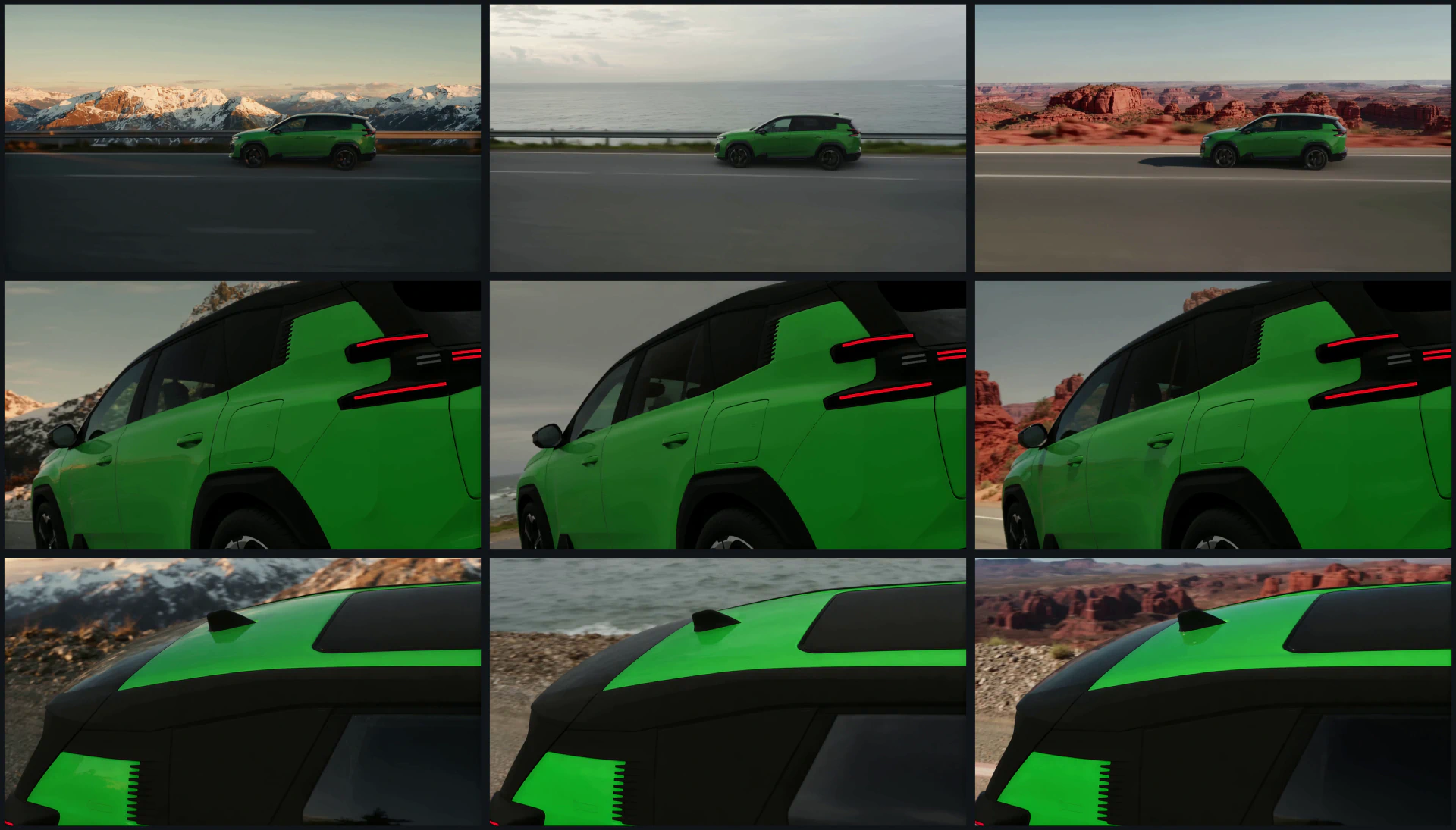
Enter LTX. Gear and LTX built a solution using an IC-LoRA and LTX's open weights to go from viewport visualization straight to final render. This workflow maintained product design and camera consistency while providing complete creative freedom over environment and lighting, enabling Gear to generate multiple environmental contexts with precise control, including environmental lighting that interacted with the vehicle's material finish to create polished, production-ready output. These workflows were enabled by a generative video-to-video workflow running on a fully secure, on-premises infrastructure.
The technical breakdown
Gear and LTX assembled a dataset of 50 to 100 paired final renders and viewport animations. For each pair, they also generated an image reference using an image model, capturing the lighting and environment of the final render.
They then ran the official LTX-2 trainer through an agent, prompting it to train an IC-LoRA that transforms a viewport video into a final render while respecting the image reference. Because the LTX-2 repository is configured to be easy for agents to navigate, the process was executed autonomously. Setup and full training finished on a single GPU in under a day.
With the IC-LoRA in hand, Gear then took a viewport animation of a new design and placed it in any scene, mood, or lighting setup, driven by a single image reference or a text prompt.
The results speak for themselves
The Impact
Although a small part of the pipeline, this IC-LoRA approach has enabled a repeatable workflow that scales across brands and products without sacrificing security or control. It is ready to deploy in production pipelines today, and fundamentally changes how designers iterate. Every design iteration is now presented in a fully realized environment, transforming how stakeholders evaluate and approve products from the earliest stages.
"When editing AI-generated shots, the final edit always looks off, different contrast, values, color balance from shot to shot.” says Mohamed Oumoumad, CTO, Gear Productions. “ We try to unify it in post, but 8-bit SDR leaves almost no latitude for color correction."
"With IC-LoRA training on LTX, we decide exactly what the model can change and what it can't, based on our own 3D data. The design and angles stay locked, the environment is completely flexible. For a product that changes several times a week, that's a game changer."

Related Stories