APEX: Better generation from fewer tokens
A structure-to-detail approach makes extreme latent compression more effective, helping diffusion models do more with a fixed compute budget.
Read the paper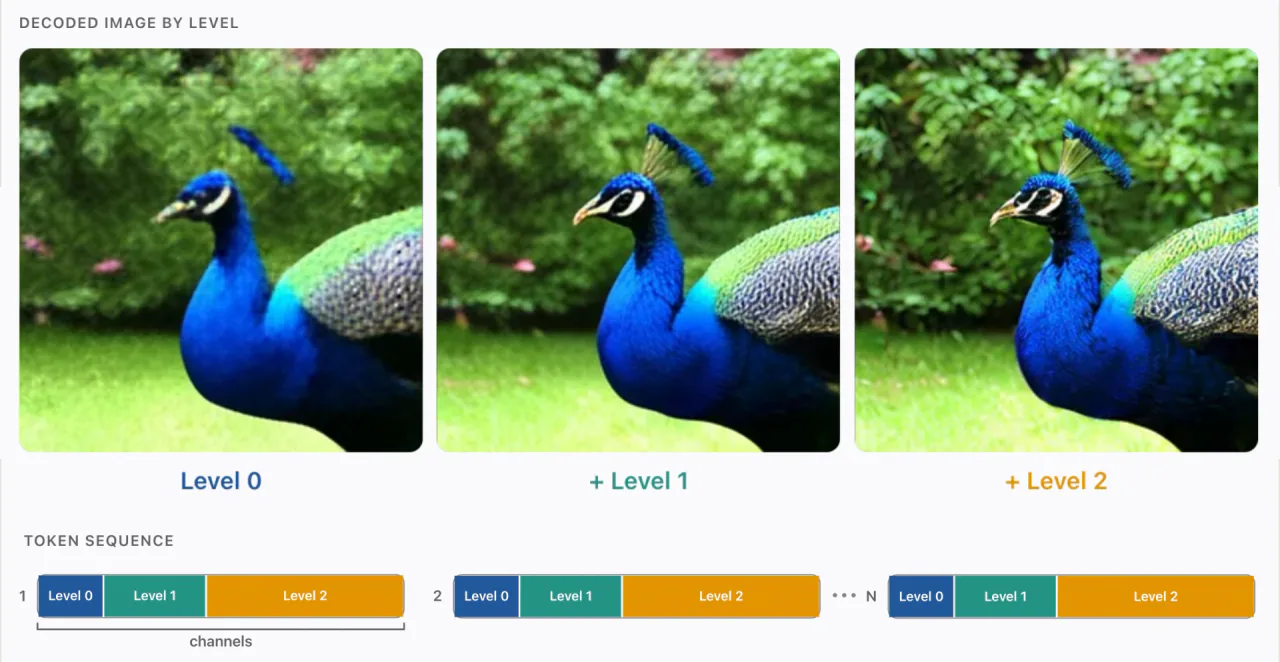
Extreme compression. High reconstruction quality. Strong generation.
Building world models requires representations that preserve the structure and detail of the world while remaining computationally efficient to generate. This brings three objectives into focus: computational efficiency, reconstruction quality, and generation quality. Historically, these objectives have competed in latent generative modeling. Fewer latent tokens reduce computation, but preserving more information within those tokens requires richer representations. Learning to generate those representations introduces greater modeling complexity.
This is why better compression alone is not enough. A useful representation must preserve information faithfully and remain tractable for generation.
APEX’s breakthrough is bringing all three objectives together: extreme compression, high reconstruction quality, and strong generation quality. It achieves this by designing the compressed representation and the generation process together. Coherent structure is established first; finer details follow, within the same small grid of latent tokens.
The compression–quality trade-off
The paper demonstrates this approach through image-generation experiments on ImageNet at 512 × 512 resolution. APEX improves generation under extreme compression while maintaining reconstruction quality comparable to the evaluated baselines. Its 64-token model also outperforms a 256-token baseline across every evaluated inference budget, with denoiser training compute matched.
For world-model development, these results point to a foundational design principle: compressed representations should be designed both to preserve information and to make that information easier to generate. APEX shows how coordinating those two goals makes better use of a limited compute budget.
Look at the iguana in the examples below. Its shape and pose are already recognizable in the first image. In the next, its scales become more distinct. In the final image, fine texture resolves across its skin. These are successive stages of one generation, produced by adding information within the same small grid of latent tokens.
That is the idea behind APEX, short for Asynchronous Prefix denoising for EXtreme compression. Developed by researchers at Lightricks and the Hebrew University of Jerusalem, APEX organizes a compressed representation from structure to detail and generates those parts on staggered schedules. One shared Transformer handles the process without adding spatial tokens.
On ImageNet at 512 × 512 resolution, APEX improves generation at both 64× and 128× spatial compression. A 64-token APEX model also outperforms a 256-token baseline across every evaluated inference budget when denoiser training compute is matched. The result points to a practical way to make aggressive compression useful for generation.
Why fewer tokens are harder than they sound
Latent diffusion models generate in a learned, compressed space before a decoder turns the result into pixels. The autoencoder determines the size and content of that space. For Transformer-based denoisers, fewer input tokens reduce computational work, including attention operations whose cost grows quadratically with sequence length.
Consider a 512 × 512 image. With 32× spatial compression, the latent grid is 16 × 16: 256 spatial positions. At 64×, it is 8 × 8: 64 positions. At 128×, it is just 4 × 4: 16 positions. In the paper's main models, each position becomes one Transformer token.
A smaller grid still needs enough capacity to represent the image. One way to preserve it is to increase the number of channels: learned feature values stored at each spatial position. They carry information that the decoder uses to reconstruct the image.
This creates the reconstruction–generation dilemma. More channels can help an encoder preserve exact textures and local details from an existing image. But a generator must learn to produce all that information from noise. A representation that reconstructs well can therefore be difficult to generate. Compressing the grid and widening every token does not, by itself, solve the problem.
Teach the latent to build an image in levels
APEX gives those channels an order. Early channels represent coherent structure; later groups add detail. Each level contains all the channels before it, plus a new group. The paper calls this a cumulative prefix.
Levels 1–2 are zeroed.
Take the three-level f64c8–32–128 configuration. The “f64” means 64× spatial compression, while 8, 32, and 128 are cumulative channel counts. The groups therefore add 8, then 24, then 96 channels. All three levels use the same 8 × 8 spatial grid, keeping the token count at 64.
During autoencoder training, APEX randomly selects a level, retains its prefix, and zeroes the remaining channels. A shared decoder reconstructs the image at full resolution. Both the reconstruction and target are then resized before the loss is calculated: 128 × 128 for the first prefix, 256 × 256 for the second, and 512 × 512 for the complete latent.
That resolution matching gives each prefix a suitable job. A narrow prefix learns layout and shape at a scale it can support. Later prefixes have the capacity and supervision to recover finer information. When every prefix is trained against a full-resolution target instead, early levels can spend capacity on isolated sharp edges without preserving the surrounding structure.
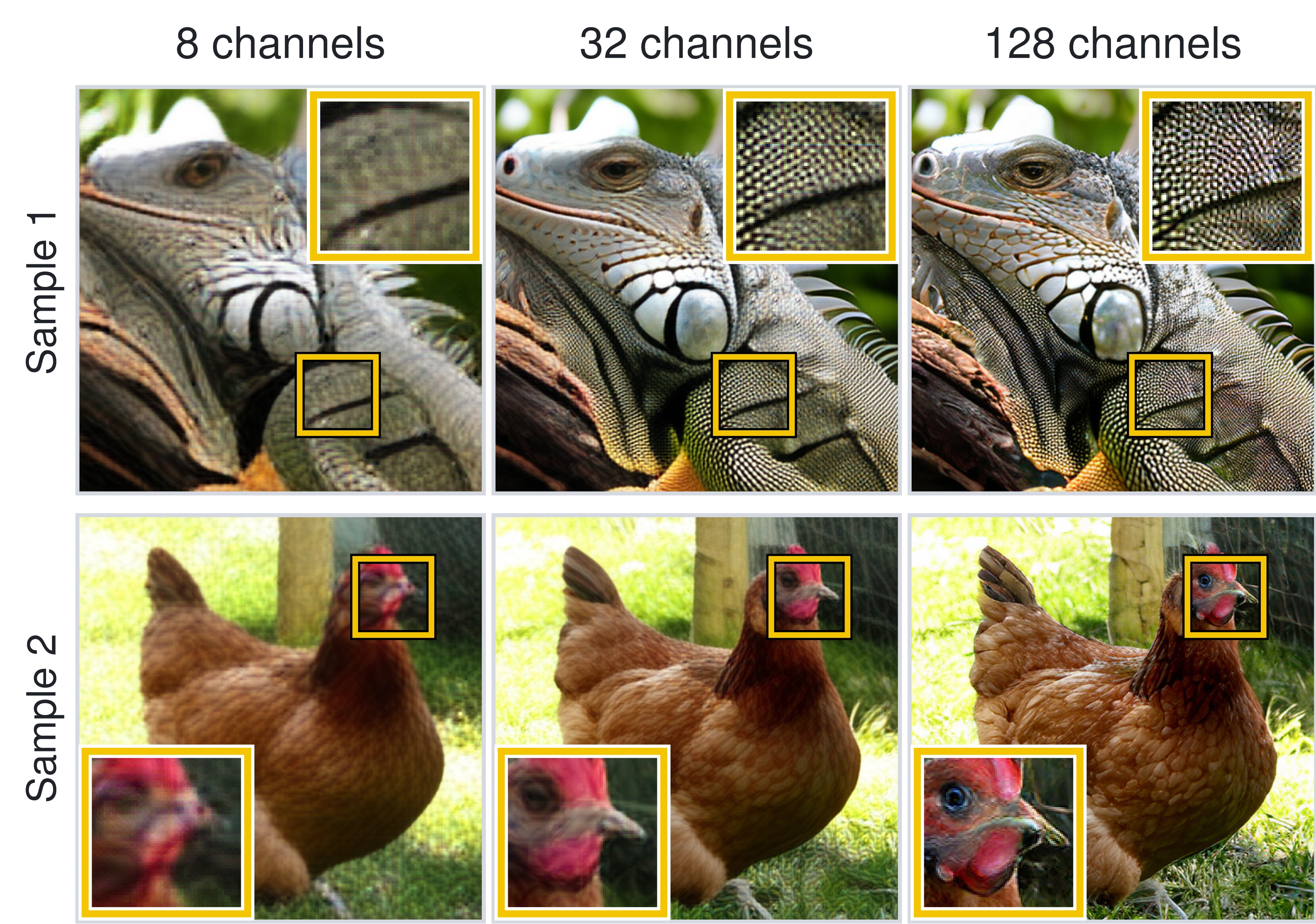
The iguana makes the progression visible: an established head shape becomes a surface of distinct scales. In the hen example, the broad body and setting appear early, while feather texture and facial features sharpen later. These are generated samples, not reconstructions of input photographs. They illustrate how additional channels refine an already coherent image.
Give detail cleaner structure to work with
Organizing the latent is only half the method. APEX also changes when each channel group is denoised. A single global timestep coordinates separate local noise levels, so earlier groups are always at least as clean as the later groups they help condition.
Each group ℓ follows its own local time on the shared clock: tℓ(τ) = clip(1 + ℓ·g − τ, 0, 1), where g is the stagger gap. For the three-level example, the main schedule uses g = 0.25. Level 0 denoises over global time 0 to 1. Level 1 runs from 0.25 to 1.25, and Level 2 from 0.5 to 1.5. The windows overlap: refinement begins while structure is still developing, with earlier levels already further along.
Sample one global time.
Before a group starts, its input is zero. When its window opens during sampling, it is initialized with Gaussian noise. While active, it is denoised at its own local time. Once complete, it stays fixed and provides clean context for the remaining groups.
One shared Transformer predicts updates for all groups at each step. Only active groups receive updates, and the process keeps the same spatial token count throughout. APEX changes the representation, conditioning, and training procedure without changing the Transformer trunk. The input-projection rows for later groups start at zero, so the model begins as a Level 0 generator and learns to use refinement channels during training. At a given latent shape, its shared update has the same per-step cost as the corresponding flat model.
Training follows the same staggered process. Errors are averaged within each active group, then weighted equally across active groups, preventing wider refinement groups from dominating simply because they contain more channels. The main models place 90% of training-clock probability in the interval where Level 0 is active. Overlapping refinement groups train there too; the remaining 10% covers the later part of the clock.
Better generation for the same compute
The main advantage of using fewer tokens is computational efficiency. A smaller latent grid makes each denoising step cheaper, allowing the model to take more steps within the same inference budget. But this advantage is only useful if the compressed representation can still support high-quality generation.
APEX makes that trade-off worthwhile. In the main experiments on ImageNet-512, a 64-token APEX model outperforms a 256-token DC-AE baseline across every evaluated inference budget, with matched denoiser training compute.
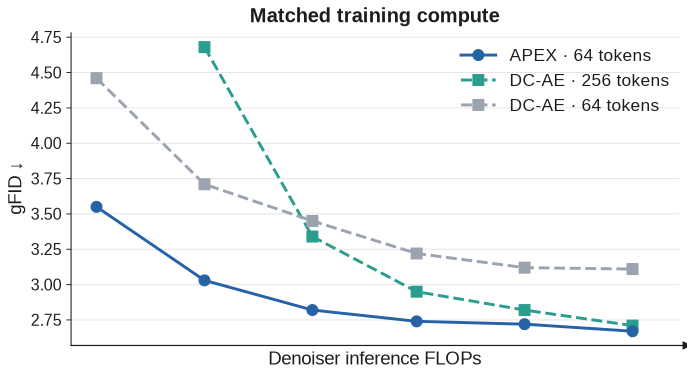
At the 1× budget, APEX reaches 2.74 generation Fréchet Inception Distance (gFID), compared with 2.95 for the 256-token baseline. Lower is better. Because each evaluation is cheaper, that budget allows 250 function evaluations for APEX versus 64 for the larger-token model. Each model uses its best evaluated classifier-free guidance scale at each budget.
The advantage holds as the inference budget decreases. Rather than sacrificing generation quality for a smaller latent grid, APEX makes it possible to realize the computational benefits of higher compression.
A separate experiment demonstrates a similar advantage during training. A 64-token APEX model matches the published 2.62 gFID of a 1,024-token SD-VAE SiT-XL configuration using approximately 15% of its denoiser-training FLOPs.
Making high compression work
The reason APEX can benefit from fewer tokens is that it makes highly compressed representations easier to generate. This becomes particularly important as the number of latent channels increases.
Adding channels allows the autoencoder to preserve more information and improve reconstruction quality. However, conventional diffusion models struggle to generate these increasingly complex representations. As channel counts grow, generation quality can deteriorate sharply, even as reconstruction improves.
At 64 tokens, increasing the channel count from 128 to 256 to 512 changes APEX's guided gFID from 2.85 to 3.15 to 4.90. The flat DC-AE baseline deteriorates much more sharply, from 3.22 to 9.19 to 26.10.
The difference also holds at 128× spatial compression, where a 512 × 512 image is represented by just 16 tokens. With 512 channels, APEX reaches 8.98 gFID, compared with 11.86 for the closest baseline, DC-AE 1.5. At 1,024 channels, APEX reaches 18.77, compared with 89.47 for flat DC-AE.
These comparisons use matched denoiser training FLOPs and sampling evaluations, with comparable full-latent reconstruction quality at each configuration. Although APEX's generation quality also declines as channels increase, the deterioration is substantially smaller than with conventional approaches.
This is what makes the computational savings possible. Higher spatial compression reduces the number of tokens, while additional channels provide the capacity needed to preserve reconstruction quality. By making these representations more tractable for diffusion models, APEX enables more aggressive compression without the same penalty in generation quality.
What builders can take from APEX
The practical lesson is to design the compressed representation and its generator together. Reducing tokens creates a compute opportunity, but the denoiser needs a tractable way to use the information packed into each token. APEX gives detail a structural context and makes that ordering explicit in training.
The paper offers useful starting settings. A stagger gap near 0.25 performs best in the reported sweep. Larger gaps provide cleaner context but lengthen the trajectory, reducing the effectiveness of a fixed sampling budget. Training concentrated on the structure-generating interval helps, while retaining some later-clock coverage matters for deeper hierarchies. Every level contributes. With the smaller SiT-B/1 denoiser, stopping generation after Level 0, Level 1, or Level 2 gives 19.83, 9.04, and 8.12 gFID.
Several choices remain manual: channel boundaries, target resolutions, the stagger gap, and the training-clock distribution. Their best values may change across models and datasets. The reported experiments cover image generation; extensions to video and production LTX systems need their own validation.
APEX is foundational efficiency research on the latent and tokenizer stack, the cost layer of generative models. It shows that the latent representation is an important place to improve generative efficiency. By learning what to generate first and what to refine later, a model can make much better use of a small token grid. The paper's appendices provide training and inference pseudocode, exact configurations, evaluation protocols, and compute accounting for researchers who want to investigate the approach.
Explore the research: Read the APEX paper · Project page
Meet the Authors

David Dinkevich is a PhD student at the Hebrew University of Jerusalem, advised by Prof. Dani Lischinski. He works on diffusion models for images and video, focusing on efficient representations and controllable generation. His recent work includes APEX, which enables diffusion in extremely compressed latent spaces, and Story2Board, a training-free approach to generating coherent, expressive storyboards.

Nisan Chiprut is a researcher at LTX, where he works on pretraining diffusion models for multimodal generation. He helped develop the LTX family of models, including LTX-Video and LTX-2. His earlier research explored 3D reconstruction and convex optimization. He received his master’s degree from the Hebrew University of Jerusalem, advised by Prof. Ami Wiesel.

Yoav HaCohen is VP Research at LTX, where he leads the Model Foundations Group, the team behind LTX’s open-source video generation model. He joined LTX in 2020, and in 2022 he founded the company's foundation model effort, growing it into a research group spanning data, architecture, pretraining, post-training, and evaluation. He holds a PhD in Computer Science from the Hebrew University of Jerusalem.

Dani Lischinski is a full professor at the Hebrew University of Jerusalem’s School of Computer Science and Engineering. He earned his PhD from Cornell University in 1994 and was a postdoctoral research associate at the University of Washington until 1996. He spent a sabbatical year at Pixar Animation Studios in 2002–03 and received the Eurographics Outstanding Technical Contributions Award in 2012. In 2017, he served as Technical Papers Chair for SIGGRAPH Asia.
