
The future of creative production will be defined by accessible, powerful AI models. That's why we've committed to building LTX open-weights AI models for creative production. Let me share our vision for LTX and what comes next.
A Strategic Shift
At the end of last year, we made the decision to restructure internally and accelerate our investment in LTX, our generative AI creative production business. We believe the market needs powerful and efficient creative AI models for companies and creators to achieve more. And we know that open-weights models with commercial licensing enable highly customized creative production tools that are far more powerful than anything else available.
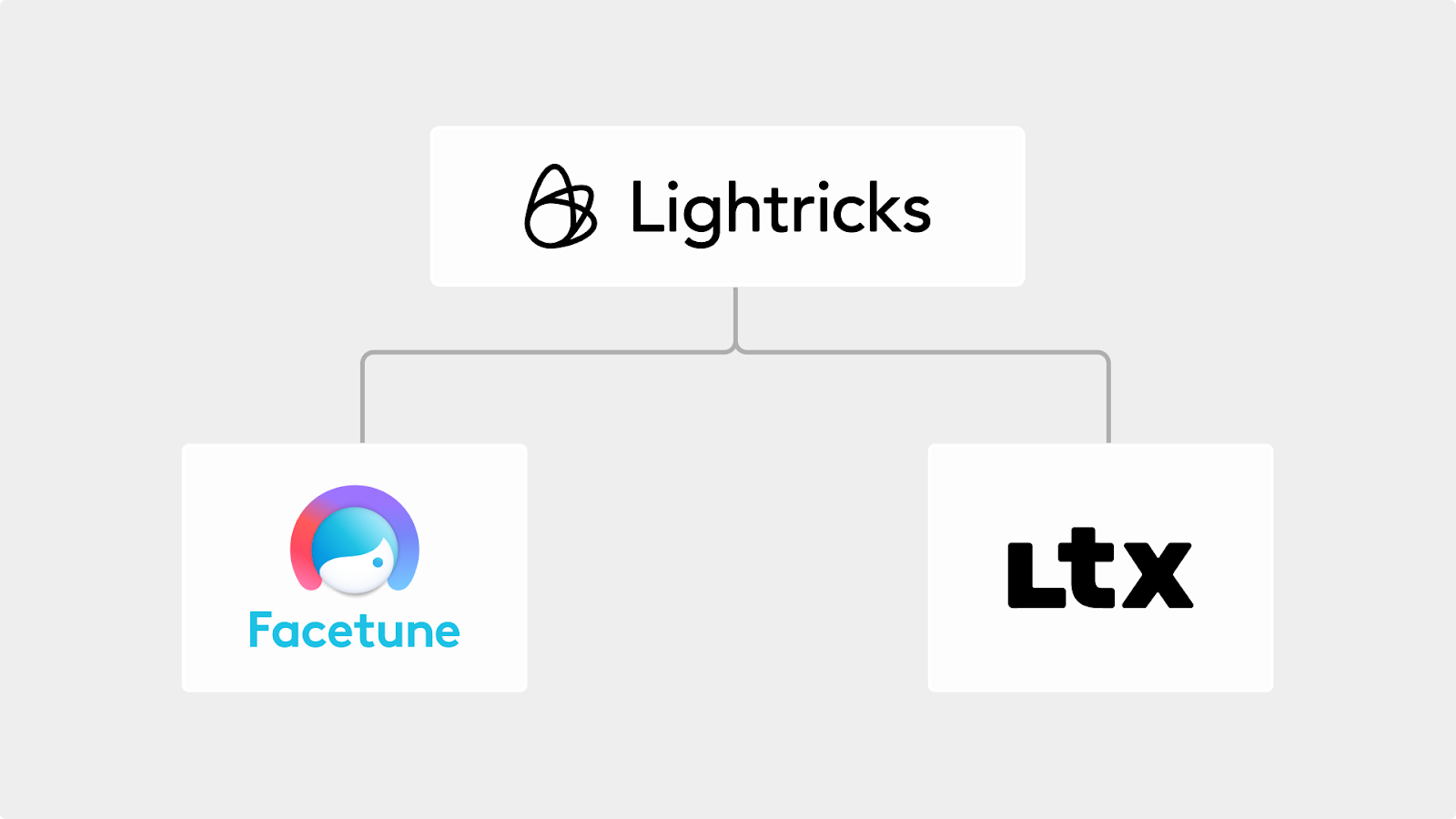
With that vision in mind, today we are taking the next step, dividing into two business units: Facetune and LTX. This enables us to continue growing Facetune, our mature B2C business, while hypercharging the growth of LTX. Our goal is for LTX to provide powerful and efficient AI video creation tools that expand what can be achieved creatively.
Self-Funded Innovation, Built on the Strength of Our Apps
Unlike many other players rushing to build AI models funded by external capital, LTX has been fully self-funded by the success and profitability of our existing business. Our teams built strong, sustainable consumer products first, and that financial foundation has given us the independence to invest in long-term research and product development without compromise.
Every dollar we've put into LTX has been earned from users who love our tools and trust our brand.
Our willingness to invest in AI video generation models was rooted in two foundational beliefs:
- Making open-weights AI creative production efficient enough to be accessible to businesses and creators big and small will democratize the industry.
- We have the experience, track record, and technology to lead in this space.
Our experience gave us the discipline and know-how to create better models more efficiently. We built LTX-2 for $150 million with a few dozen engineers, and it has had the fastest adoption ever on HuggingFace, with more than 3 million downloads in its first month of availability.
Companies, studios, researchers, and developers around the world are embracing the model because it's transparent, extensible, community-driven, and able to be tailored to each user's specific needs.
Why AI-Powered Creative Production Matters Now
There is still enormous growth ahead for generative models.video creation.
Creative workflows are being democratized. You no longer need expensive equipment and lengthy development periods just to experiment with a concept that may not work. Advertising and marketing will become massively more creative and efficient because teams can iterate quickly. And the value of a creator will be judged not by technical execution, but by creative idea quality. The spark of imagination becomes more important as AI removes technical barriers. It empowers creative people to realize complex visions quickly, creating a flatter marketplace where the best ideas win.
With LTX, a creator can go from an idea sketch to high-quality video output in minutes, freeing them to focus on what truly matters: the story they want to tell.
Open Weights: A Strategic Foundation
From day one, our approach to LTX has been rooted in openness.
We released LTX-2 as an open-weights model with commercial licensing because we believe the best creative tools should be transparent, extensible, and adaptable. When creators and developers can see how a model works, fine-tune it for their specific needs, and run it in their own environments, something powerful happens: they build things we never anticipated, solve problems we never considered, and push the technology in directions that benefit everyone.
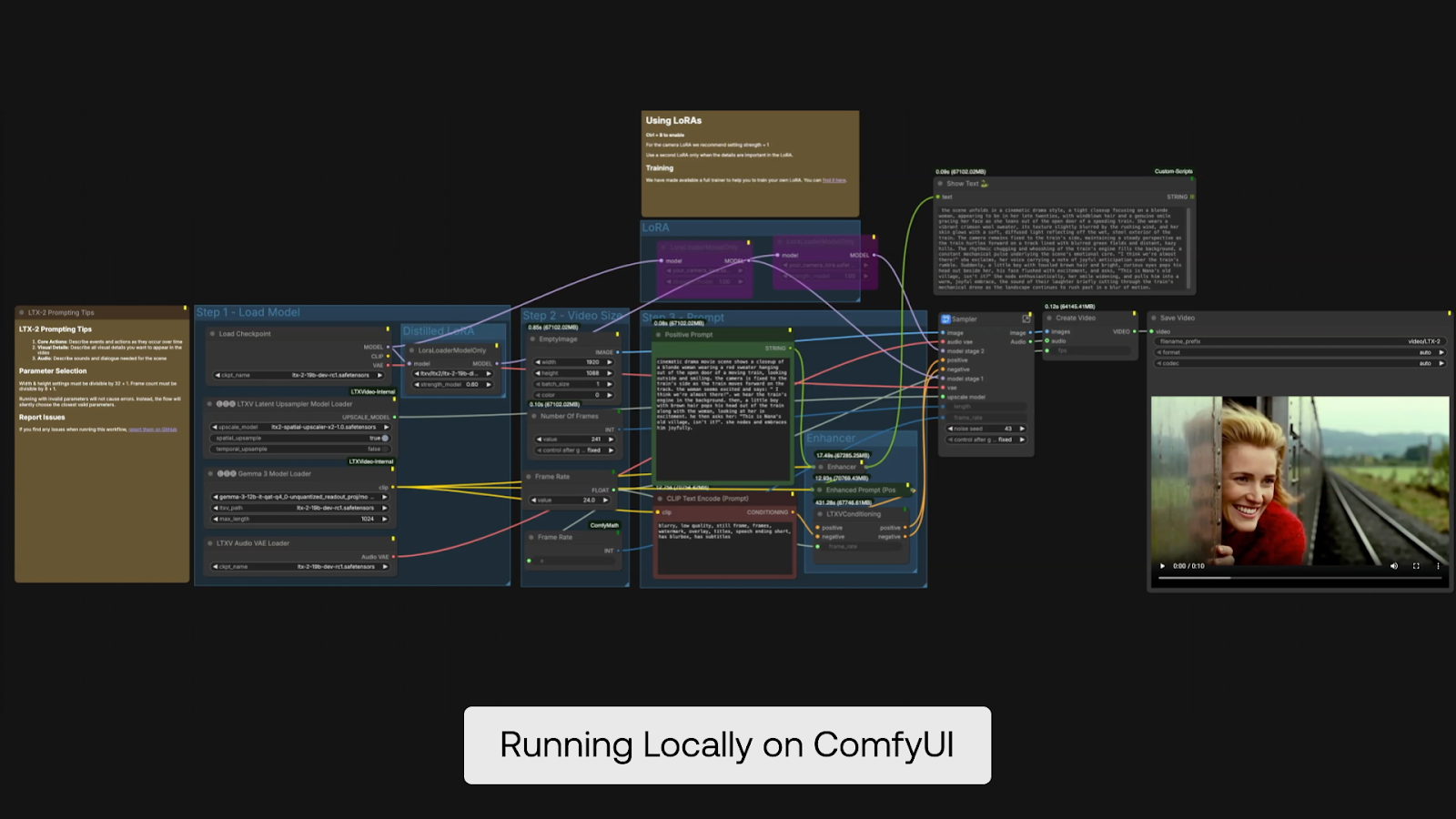
Three million downloads in the first month. Enthusiasts building optimized ComfyUI workflows on NVIDIA RTX 5090 and 50 Series GPUs. Developers integrating LTX-2 into production pipelines across industries. HuggingFace CEO Clem Delangue sharing our 1M downloads milestone. Nvidia showcasing LTX-2 at CES. We're grateful for the community that's made this possible.
But open weights aren't just a distribution strategy for us. They're a fundamental commitment to how creative AI should work.
When a model is open, it can be fine-tuned for specific brand aesthetics, trained on proprietary visual styles, and deployed in controlled environments where sensitive IP never leaves the building. It means an indie creator with a powerful GPU has the same generative foundation as a major studio. It means researchers can validate claims against public benchmarks rather than trusting marketing materials.
And it means the entire ecosystem moves faster. Every improvement, every optimization, every creative workflow the community develops makes the technology better for everyone.
Putting Advanced Tools Into Everyone's Hands
Democratization has always been the vision behind LTX.
Independent creators with modest budgets should have the same generative capabilities as big studios. Our models can run locally on high-end consumer GPUs, enabling creators to experiment without cloud dependency. This reduces cost, time, and energy usage, while increasing control over valuable IP that doesn't need to leave local servers.
Big studios should be faster and more creative, without the barriers of cost and time.
Compared to closed models like Sora, LTX-2 can achieve similar output quality at approximately 1/8 the cost, with roughly 1/7 the rendering time, and with the far greater flexibility that comes from open weights and local execution.
This is not theoretical. It's happening now.
Enterprise: Production-Ready Creative AI
As LTX-2 has matured, we've seen a clear pattern: enterprises don't just want powerful AI models. They need production-ready infrastructure that integrates into existing creative workflows, respects IP boundaries, and scales reliably.
That's exactly what we're building.
The LTX API delivers studio-quality video generation that plugs directly into the pipelines teams already use. Whether a studio is pre-visualizing scenes for a feature film, an agency is iterating on ad concepts for a pitch, or a brand is producing campaign assets at scale, LTX-2 integrates into existing workflows rather than disrupting them.
For industries where IP protection is paramount, like film, gaming, and advertising, the combination of open weights and local execution is especially powerful. Studios can deploy LTX-2 on their own infrastructure, fine-tune the model on proprietary assets, and generate content without sending sensitive material to a third-party cloud. The creative team maintains full control over their work, their data, and their output.
Early enterprise adoption has shown measurable results: up to 85% faster turnaround in pre-visualization workflows and significant production cost savings. These results point to a fundamental shift in how creative production can work when the right tools are available.
LTX Studio provides a complete creative workspace where teams can go from concept to storyboard to polished 4K output in a single environment, with collaboration, versioning, and asset management built in. The goal is to make the entire creative production pipeline faster and more accessible, from the first idea through final delivery.
What's Next
We're building LTX to become the creative AI infrastructure that professional visual content runs on. Our vision doesn't stop at video generation. It starts there.
Bringing archival content into the generative era. Soon, we expect to enable tools that can enhance existing and archival videos into 4K and beyond. There are millions of hours of valuable video content produced at lower resolutions or with older equipment. We want to give creators and studios the ability to bring that footage into today's quality standards and creative possibilities. For studios and broadcasters sitting on decades of content, this opens up entirely new ways to repackage, reimagine, and monetize existing libraries.
Full AI video inference on local devices. In the near future, we see AI video generation running entirely on local devices, including smartphones and laptops, without any cloud dependency. The efficiency gains our team has achieved with LTX-2 are what make this possible. When you can generate high-quality video on a consumer device, the creative tools in your pocket become genuinely studio-grade. That means creators will be able to iterate, experiment, and produce finished work wherever they are, with no upload latency and no per-generation cost.
Deepening enterprise integrations. We're building toward a future where LTX isn't just a model or an API, but the creative AI infrastructure that powers professional production across industries. That means deeper integration with the tools teams already rely on, more flexible deployment options, and expanded capabilities for industries like advertising, film, gaming, and e-commerce. We want to meet creative teams where they already work.
Expanding multimodal capabilities. Every model release pushes the boundaries of fidelity, control, and speed. We recently introduced audio-to-video generation, and our upcoming releases bring improved visual detail, cleaner audio, better image-to-video quality, and stronger prompt understanding. The creative palette keeps growing. When a model can take any input, text, image, audio, or video, and transform it into high-fidelity output, the range of what creators can produce expands dramatically.
Open source and enterprise, together. LTX-2 has a global community of millions of developers and builders who are the driving force behind the model's rapid evolution. They push its creative boundaries, discover new workflows, and optimize performance in ways our internal team alone never could. Enterprise customers take that same proven foundation and put it to work inside their production pipelines, with the confidence that comes from adopting a model already tested and extended by builders worldwide. These two forces reinforce each other, and that's what makes this approach so powerful.
Building for the Long Term
We're building LTX not just to compete, but to expand what's possible for anyone with an idea and a vision.
The separation of Facetune and LTX into distinct business units isn't just an organizational change. It's a signal of how seriously we're investing in this future. Facetune continues to grow as a beloved consumer brand. And LTX now has the focus, the team, and the resources to become the foundation for professional creative production in the age of AI.
I'm grateful to the teams, partners, and community helping us build this.
This is the next chapter of creativity.
Zeev
