
The landscape of filmmaking is evolving faster than ever. In 2026, the best filmmaking software doesn’t just cover screenwriting and budgeting—it extends to AI filmmaking platforms, text-to-video models, and full script-to-screen software. Whether you’re an independent creator or part of a large production team, today’s AI-powered tools are bridging creativity and technology, making it possible to plan, produce, and even generate cinematic footage with unprecedented quality and speed.
This guide will give you a high-level overview of the best software for cinematography, production planning, and screenwriting—from industry standards like Final Draft and Celtx to next-generation platforms like LTX Studio, Runway Gen-2, Moonvalley AI, and more. We’ll also explore emerging AI video creation models, including Google Veo 3, OpenAI Sora, and LTXV, that are shaping the future of how we tell stories.
Best Screenwriting Software for Filmmakers
Every great film starts with the seed of an idea. And every cinematic concept requires some form of a script. In these scenarios, the right tools can make the difference between a smooth and enjoyable writing process and unnecessary friction. In 2026, the best screenwriting software is designed to support different workflows based on what you’re prioritizing—from cloud-based collaboration to integrated pre-production planning and script-to-screen visualization.
Below, we’ll compare leading platforms so you can choose the one that best fits your creative and production needs.
LTX Studio: AI Script-to-Screen Software
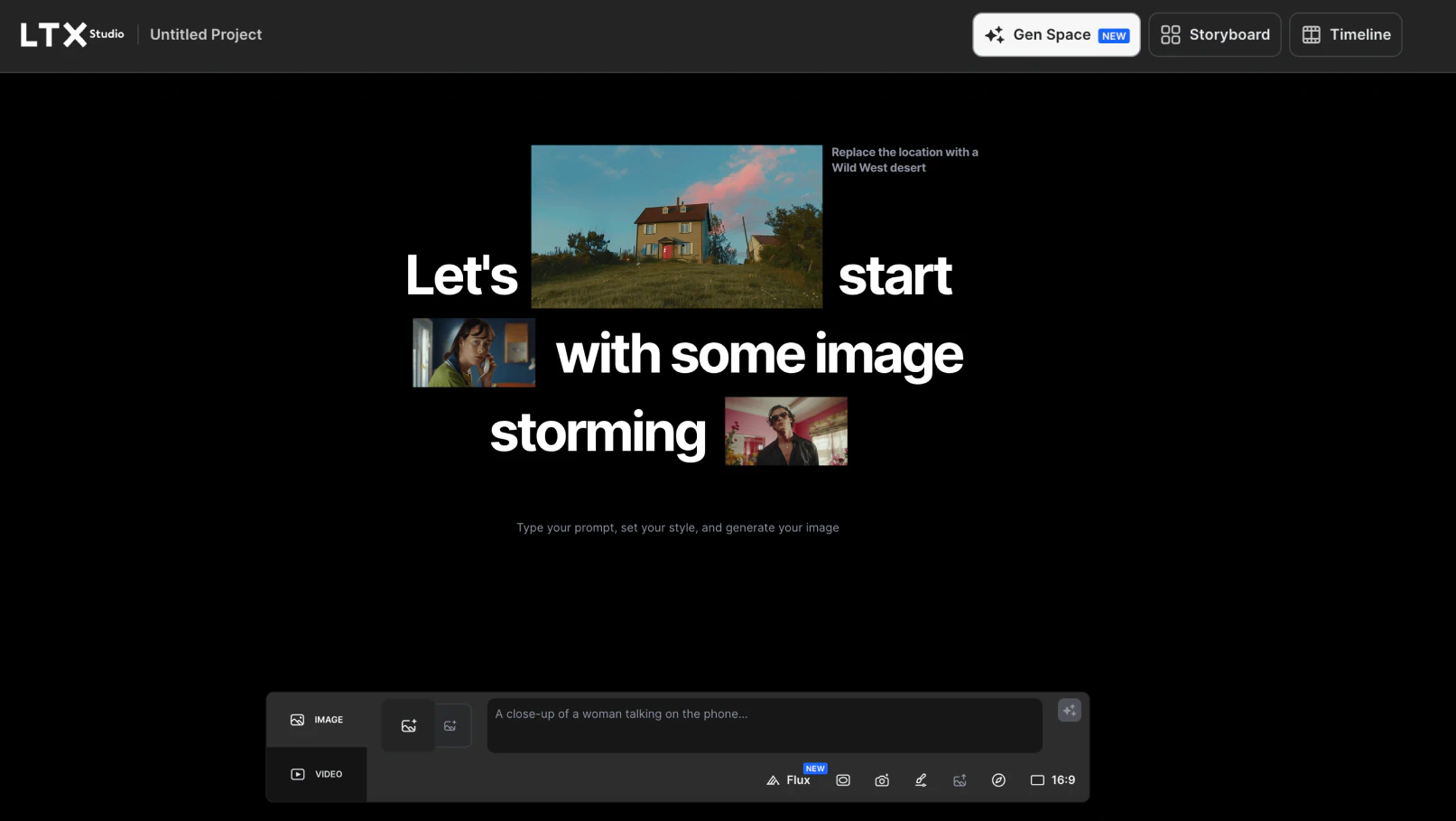
LTX Studio is more than just an app for writing—its script-to-screen software is designed specifically for filmmakers, advertising and marketing professionals, and creative professionals who think in both words and visuals. Instead of stopping at the script, the platform lets you develop concepts, storyboards, and cinematic sequences all in one place. This makes it a powerful AI filmmaking platform for users who need to translate high-level ideas into production-ready materials quickly.
Pros:
- Scriptwriting integrates directly with storyboarding tools, allowing users to see ideas instantly and eliminating the traditional gap between writing and pre-production.
- Provides flexibility to write scripts manually or use AI-assisted tools to expand and refine ideas.
- Encourages writers to develop a visual mindset, bridging the divide between text on the page and cinematic storytelling.
Cons
- Writers who prefer a text-only environment may not find the visual integration necessary.
- Doesn’t yet integrate traditional screenplay formatting standards.
- Adopting a hybrid writing-and-visualizing workflow may require adjustments for screenwriters used to the standard text-first thinking.
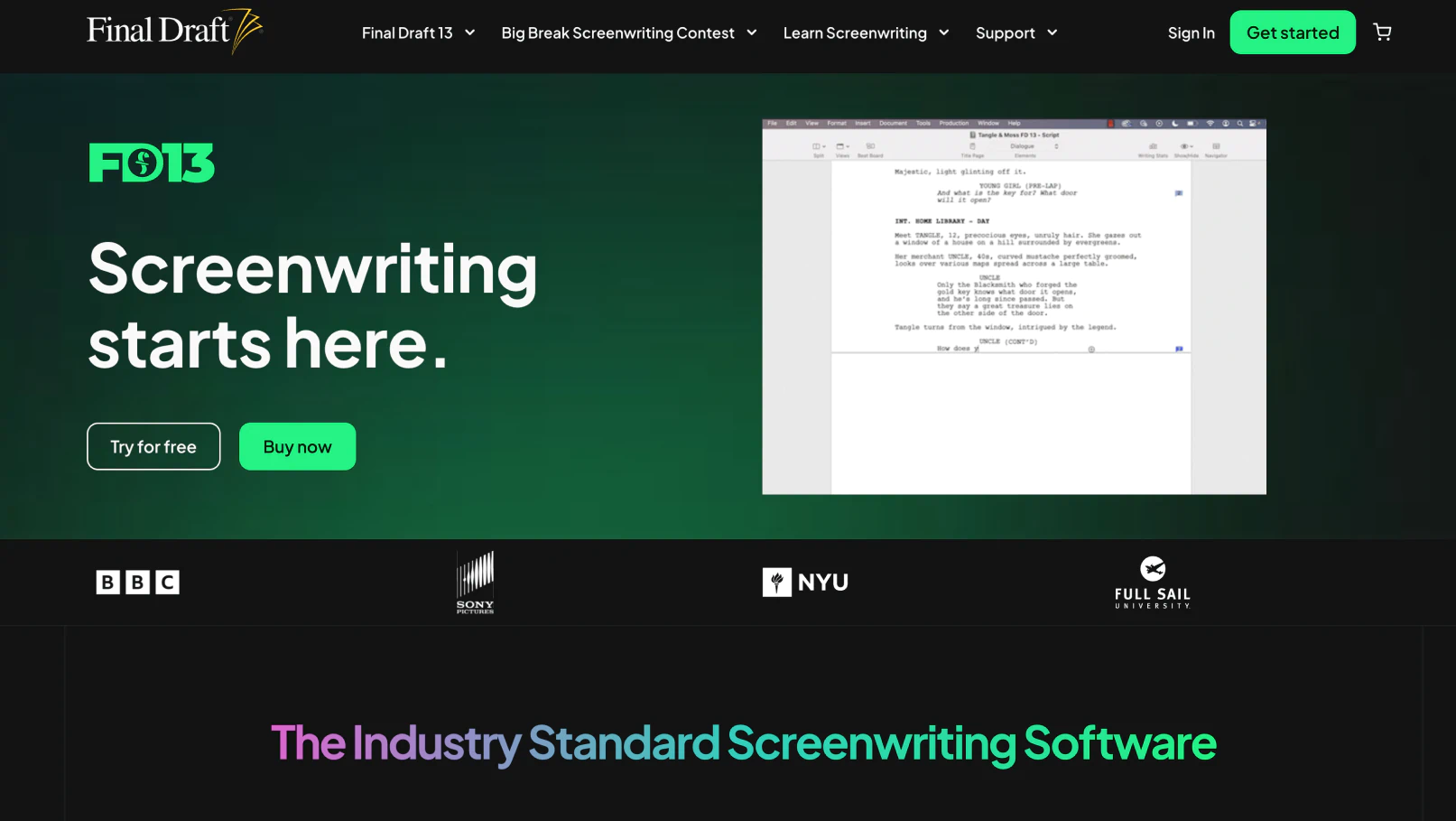
Final Draft: The Industry Standard for Screenwriting
When it comes to the best screenwriting software, Final Draft has long been the industry standard. Trusted across Hollywood, television, and theatrical performances, Final Draft is the tool of choice for any writer who needs industry-standard formatting and reliability and plans to submit drafts to producers, screenwriting contests, or for representation.
Pros:
- Integrates studio-approved formatting, ensuring scripts meet professional requirements.
- Includes revision tracking and collaboration tools, supporting collaborators throughout the drafting process.
- As the most widely recognized screenwriting tool, using Final Draft demonstrates a writer’s alignment with the film and screenwriting industry.
Cons
- Does not integrate any visualization or pre-production features.
- Lacks in-depth AI functionality, making it less adaptive for AI-forward workflows looking to integrate images or pre-production tools.
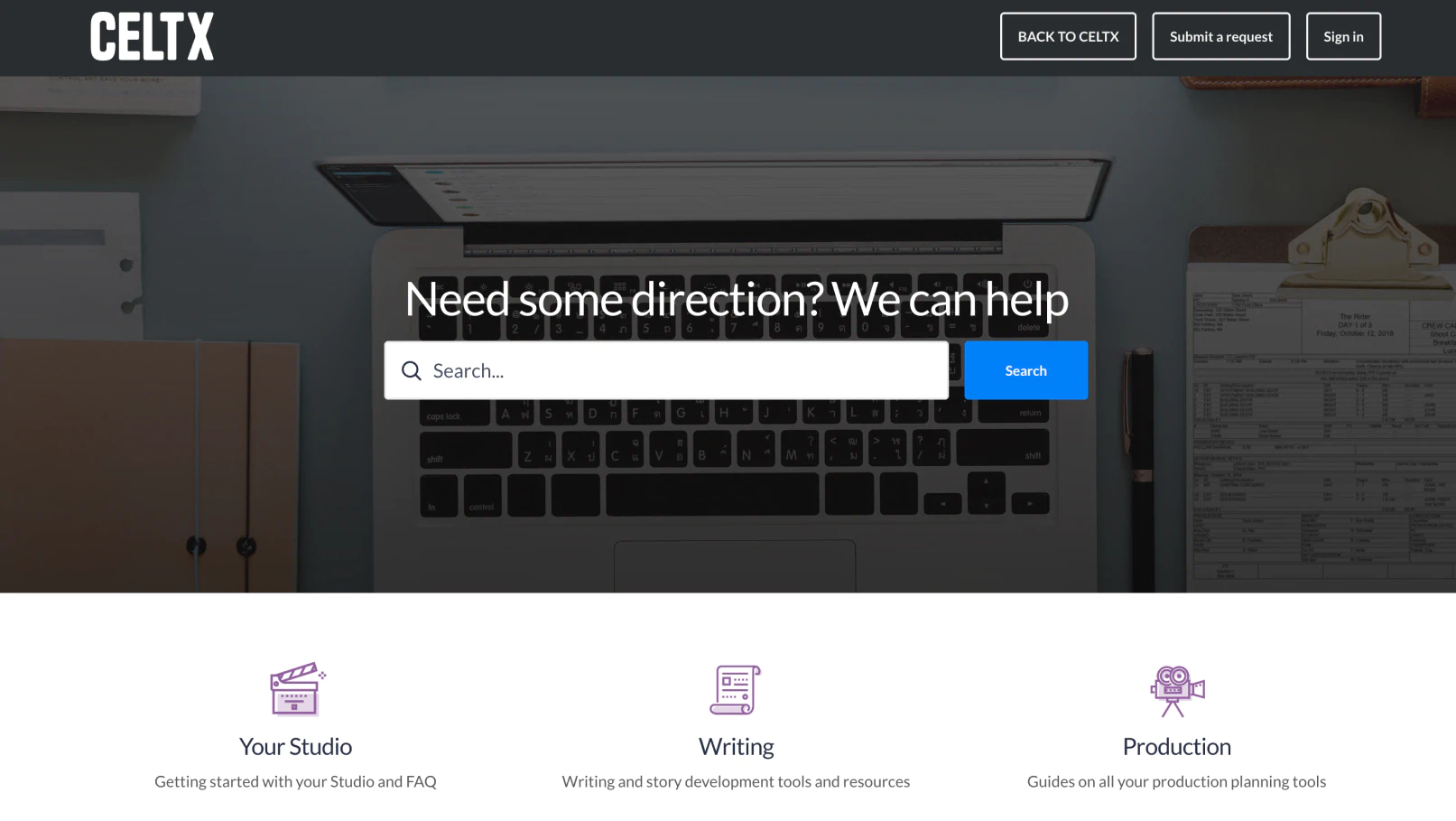
Celtx: Comprehensive Screenwriting & Pre-Production Planning
For indie filmmakers and smaller teams, Celtx is a great option for integrating screenwriting and pre-production software in one place. Celtx supports professional industry standards for script formatting while also including other important elements of the planning process, including shot lists, budgeting, and scheduling.
Pros:
- Provides one integrated workflow for filmmakers and professional creatives interested in moving from script to shotlist, to budget and so on.
- Cloud-based functionality allows teams to collaborate remotely.
- More cost-effective than Final Draft, making it more accessible for smaller teams.
Cons
- Some advanced features are only available on high-tiered plans.
- Some users report formatting issues when exporting scripts to PDFs, a big drawback given this is the primary method for professional script submissions.
WriterDuet: Real-Time Collaboration
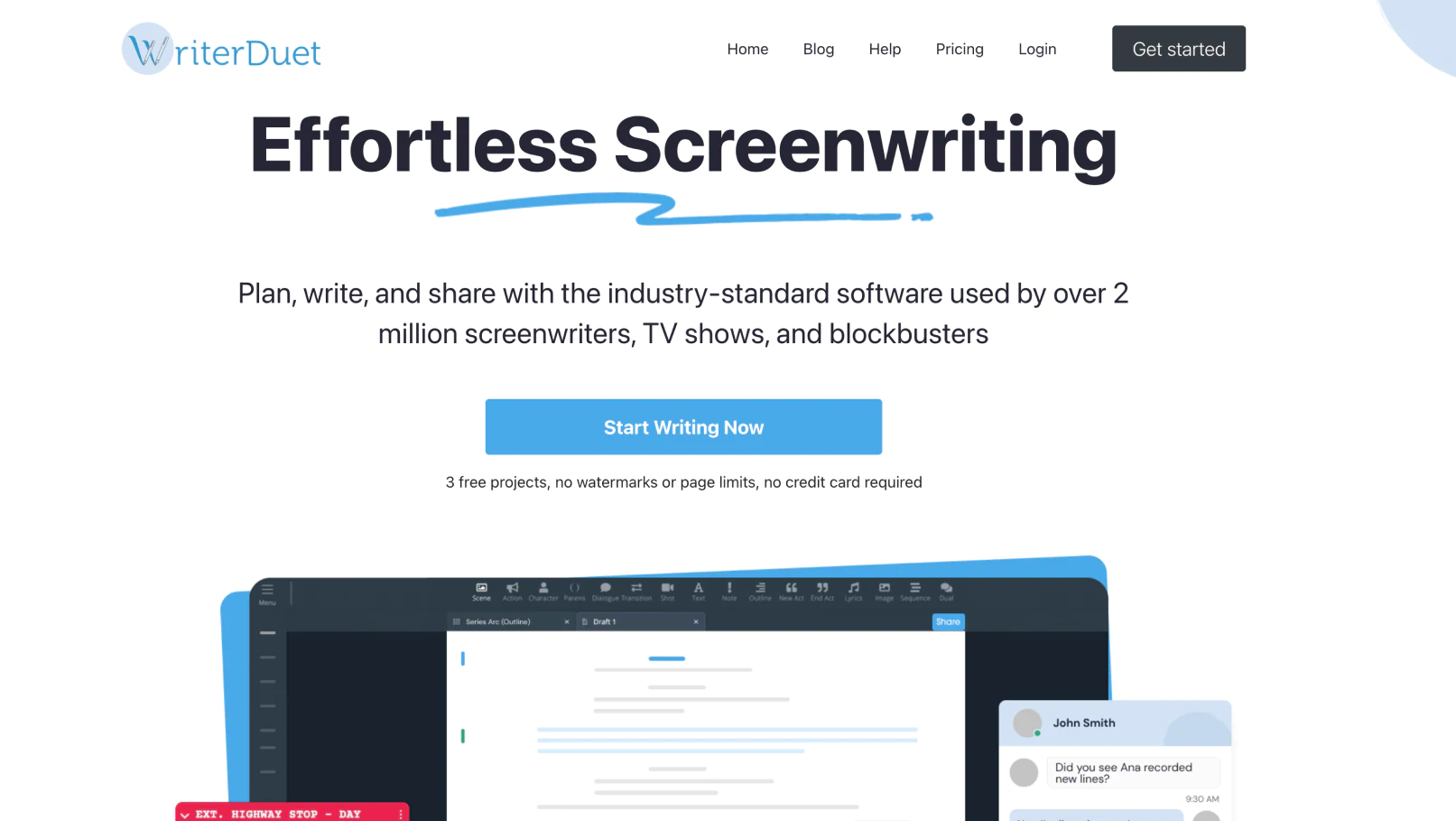
For writing teams working remotely and across time zones, WriterDuet is a leading collaborative scriptwriting tool. As a cloud-based screenwriting software, multiple users can work remotely on the same script in real time, making it ideal for remote-first workflows. This is a huge benefit for creative teams looking for clear version control on shared projects where physical distance is a part of the fabric of the project.
Pros:
- Real-time collaboration enables multiple users to draft and edit simultaneously, including collaborators who are working on the free plan.
- Strong version history and revision tracking make it easy to review new changes asynchronously and restore earlier drafts.
Cons
- Offers fewer integrated pre-production tools compared to platforms like Celtx.
- Best suited for remote-first teams—solo writers may find its collaboration-first approach less essential for their workflow.
Arc Studio: Modern AI-Enhanced Screenwriting Software
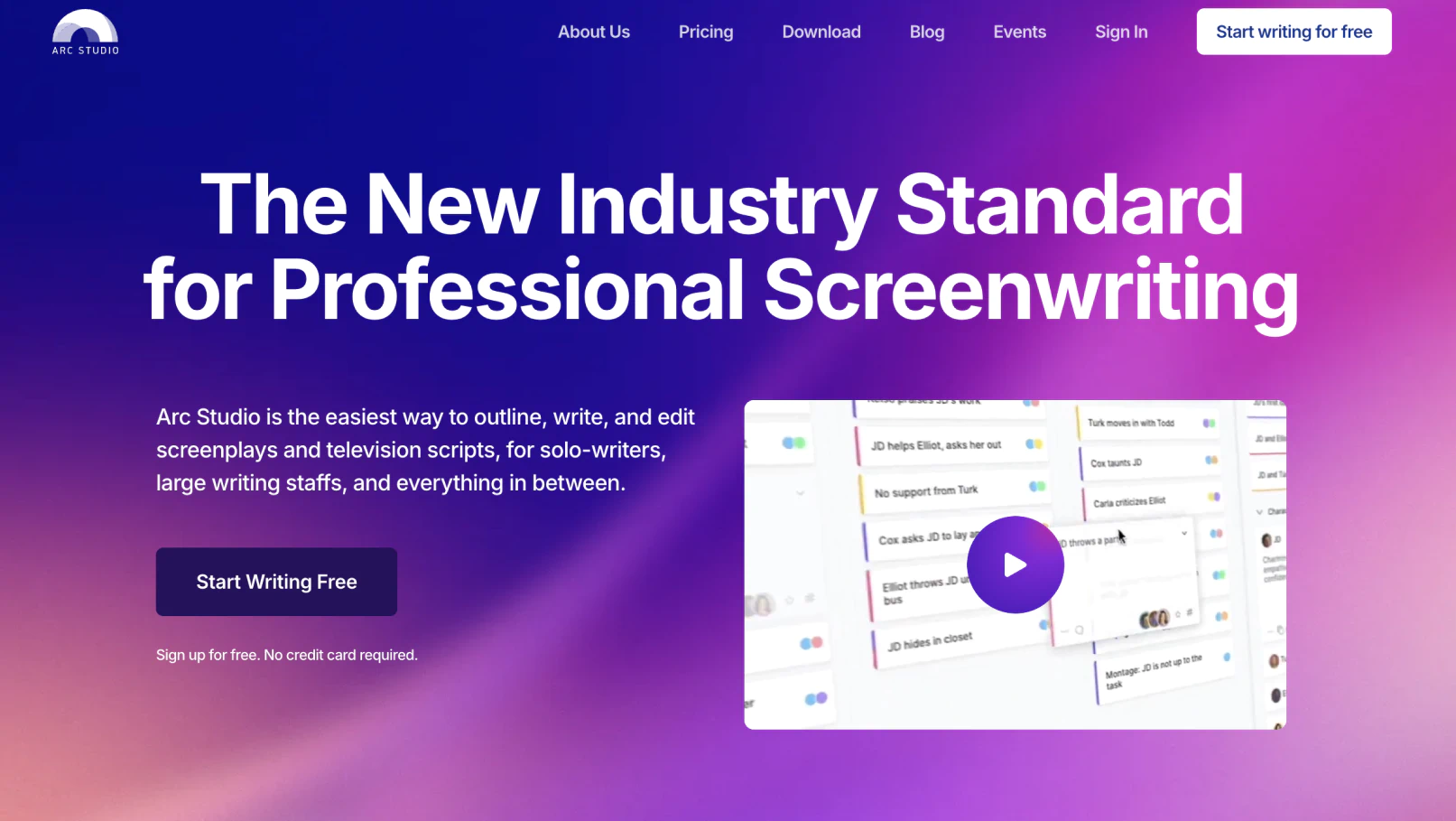
Arc Studio, a lesser-known but powerful platform, is designed for screenwriters who need a space free from distractions and optimized for story structure, while still offering the benefits of a screenwriting AI tool.
Pros
- User feedback highlights the intuitive interface, which helps writers stay focused on storytelling.
- Built-in AI tools include outlining, defining structure, and exploring alternate drafts.
- Includes collaborative features and cloud-based storage, allowing access to projects from anywhere.
Cons
- Not yet as widely adopted across the industry, making it more of a barrier for professional submissions.
- Limited pre-production integrations compared to platforms like Celtx or LTX Studio.
Best Film Budgeting & Production Management Software
Managing a film’s budget and pre-production planning means keeping track of every detail—down to the last penny. The right film budgeting software needs to handle detailed financial planning while staying connected to the creative vision of the project. Just as importantly, these production management tools should allow users to make adjustments before spending, during production spending, and after wrap, while keeping an accurate record of every change.
With something as critical as film budgeting software, here are three trusted tools filmmakers rely on to plan, track, and manage their productions effectively.
Movie Magic Budgeting: The Industry Standard for Budgeting
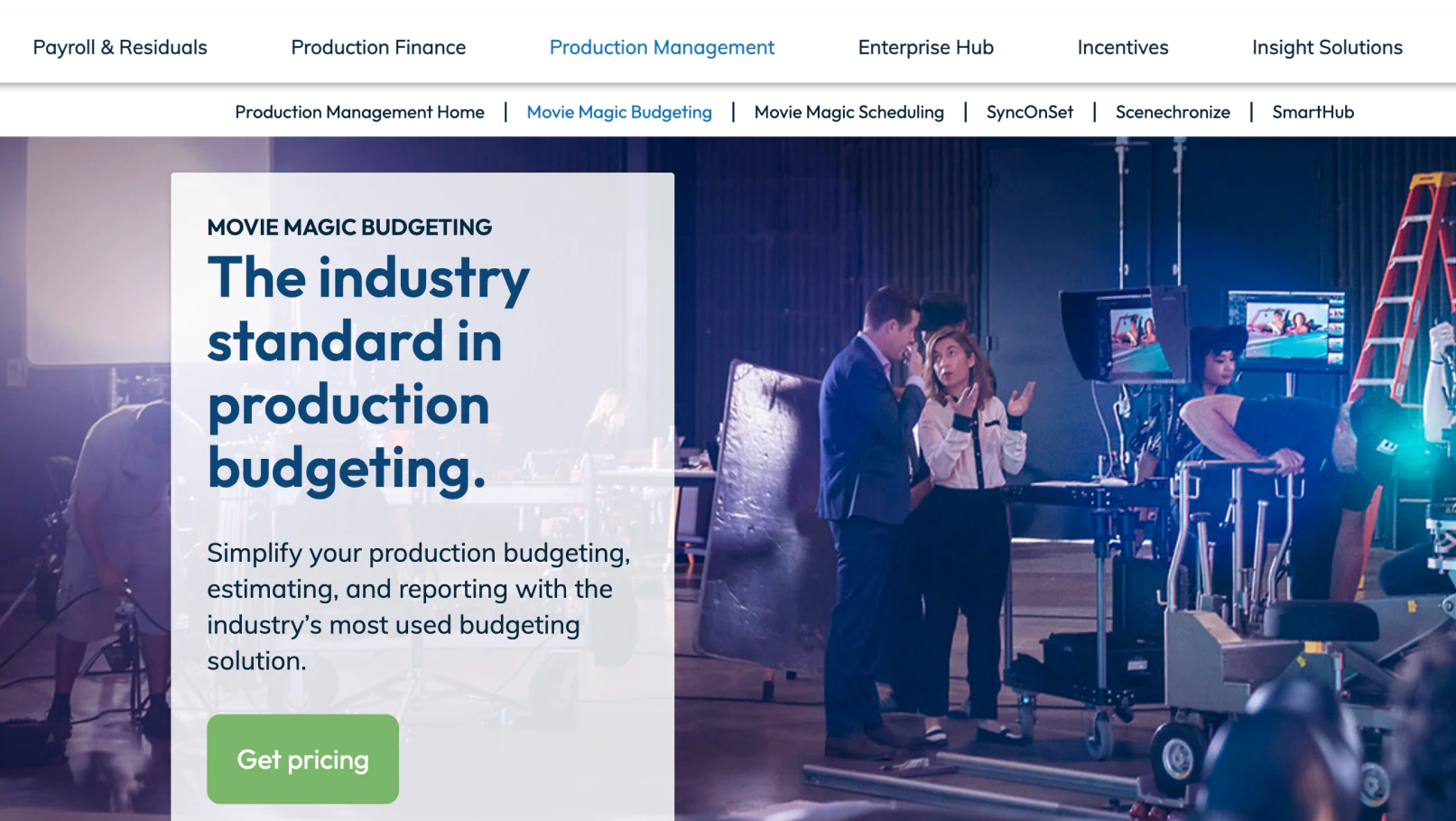
For decades, Movie Magic Budgeting has been the industry’s go-to film budgeting software. Used by major studios and independent producers alike, this is a powerful tool for breaking down complex productions into clear financial plans. As part of a wider suite of production management tools, it helps filmmakers account for every detail.
Pros
- The recognized industry standard for movie budgeting software.
- Customizable categories and templates allow producers to work from a predefined structure while also adding their own specific details based on their project.
- It integrates with other scheduling and production management tools, making it useful through pre-production.
Cons
- Its complexity can create a steep learning curve, especially for smaller teams or indie filmmakers.
- Higher licensing costs make it less accessible compared to more affordable alternatives.
Celtx’s Production Suite: Integrated Workflow Management
Celtx extends beyond screenwriting to provide a full production suite that connects creative development with budgeting and scheduling. For small to mid-sized productions, it offers a cost-effective way to keep projects on track without juggling multiple platforms.
Pros
- More affordable than high-end budgeting tools, while still offering strong functionality.
- Seamless integration from scriptwriting to shot lists, scheduling, and budgeting.
Cons
- Advanced features require paid plans, which can add up for larger teams.
- Less robust for complex, studio-level productions compared to Movie Magic.
Gorilla Budgeting: The Indie Filmmaker’s Alternative
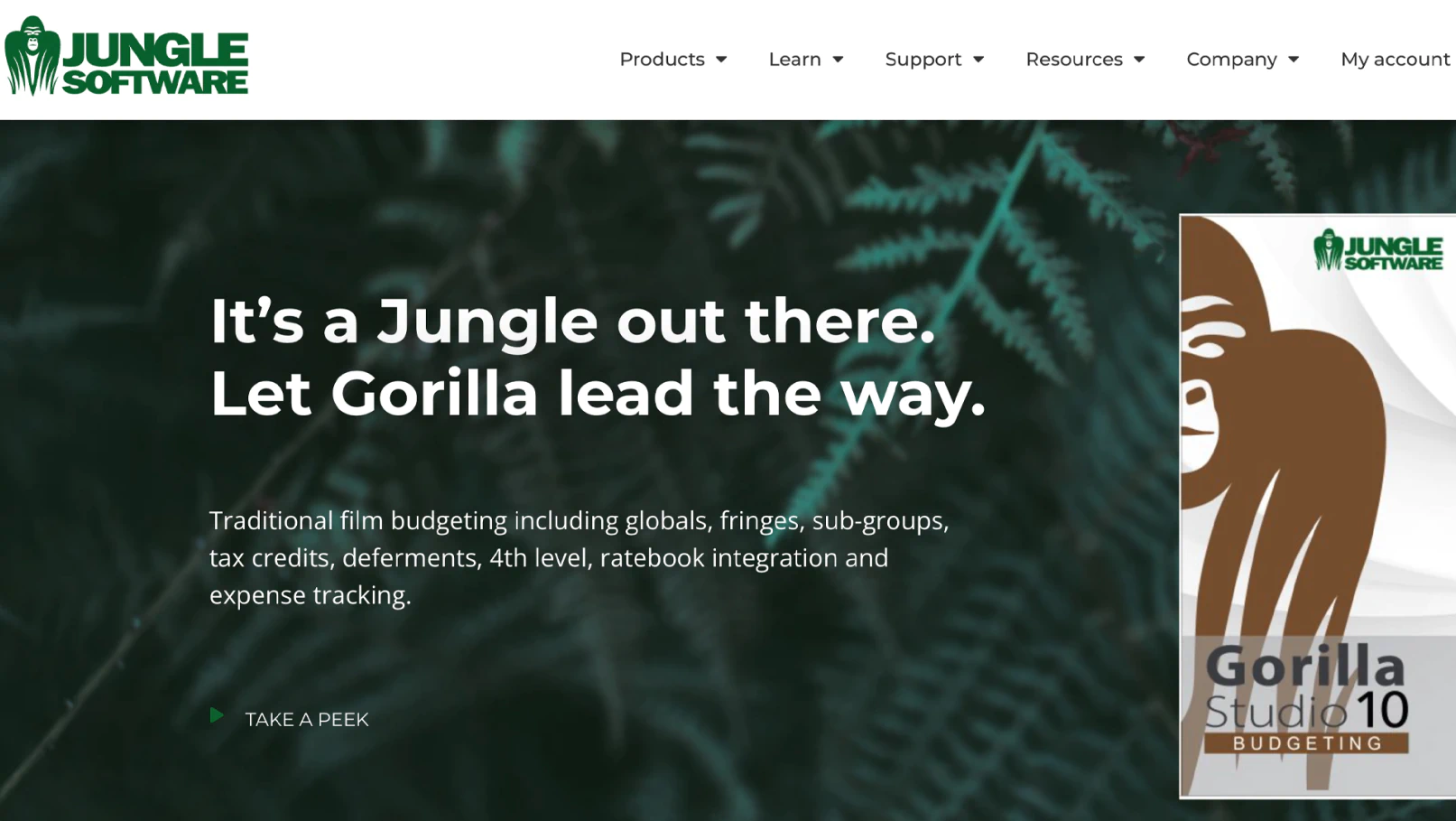
Gorilla Budgeting is designed with independent filmmakers in mind, offering intuitive tools for scheduling and cost management. It’s a practical choice for smaller teams who need professional-level organization without the overhead of big-studio software.
Pros
- Affordable alternative to Movie Magic, with strong budgeting and scheduling tools.
- Includes a user-friendly interface that’s easier to navigate and learn for first-time or green producers.
Cons
- Lacks the advanced customization and industry recognition of Movie Magic.
- Limited integration with other production tools compared to Celtx.
Best AI Filmmaking Platforms
While the previous sections focused on specific stages of production, it’s equally important to consider how AI-powered filmmaking platforms support the filmmaking process as a whole. Whether you’re mapping out a protagonist’s journey or building a storyboard, these tools are designed to help filmmakers and video creators work more efficiently, reduce costs, and unlock new creative possibilities.
LTX Studio: End-to-end AI Script-to-Screen Platform
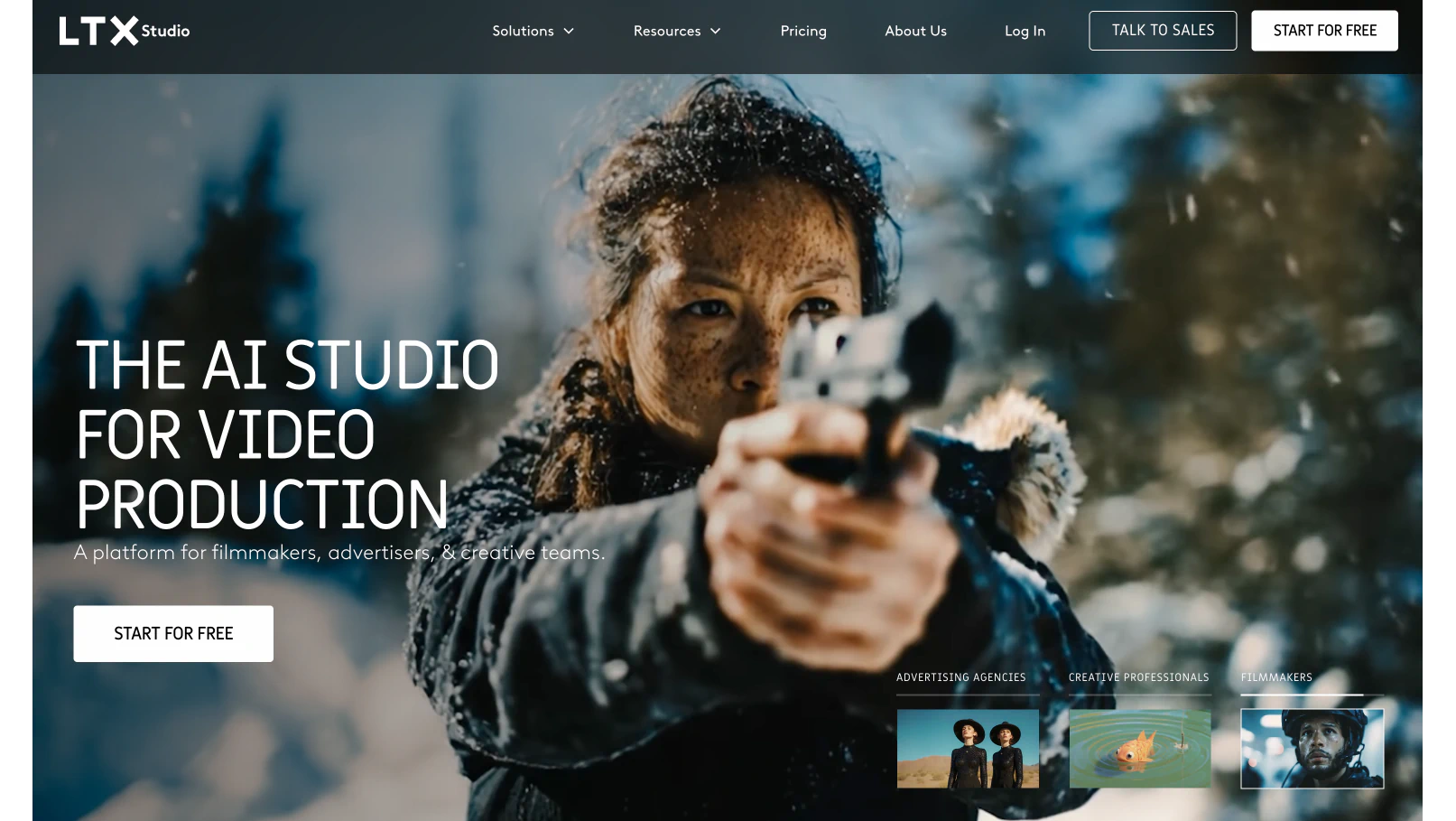
LTX Studio is a professional script-to-screen software and AI filmmaking platform designed for creators who want to move seamlessly from writing to visualization. Built with filmmakers, agencies, and production companies in mind, it bridges the gap between text and visuals—optimized for cinematic storytellers who value efficiency, iteration, and high-quality outputs in professional-grade workflows.
Pros
- Combines writing, storyboarding, shot planning, and cinematic visualization in one environment, cutting iteration time significantly.
- Supports multiple AI filmmaking models, giving creators control over cinematic style, character consistency, and narrative complexity.
Cons
- Requires adapting to a visual-first workflow, which can feel unfamiliar to writers used to purely text-driven tools.
- Still building industry recognition compared to tools like Final Draft.
Runway Gen-2: Multimodal AI Video Creator
Runway Gen-2 (part of Runway ML) allows users to generate content from text, images, or video clips. A popular tool for prototyping, creating visual effects, and rapid creative iteration, Runway Gen-2 offers various modes and models. Often praised for its intuitive nature, this platform supports creators as they transition from concept to video, whether they are enthusiastic beginners or industry professionals.
Pros:
- Flexible multimodal generation (text-to-video, image-to-video, and video editing).
- Tools like background editing and stylization make it useful for VFX and experimental filmmaking.
Cons:
- Users report inconsistent prompt-following and “warped” outputs, making results unreliable at times.
- May require generating many clips to achieve a usable result.
Moonvalley: Ethical AI Video Model for Filmmakers
Moonvalley AI is the first AI video generator trained entirely on licensed, commercially safe data, giving studios confidence in copyright compliance. It delivers cinematic-quality outputs with precise control over visuals.
Pros
- Provides legal and ethical peace of mind by only sourcing data with creator consent and copyright approval.
- Offers 1080p video generation with customizable camera motion control.
Cons
- As a newer entrant in the AI-filmmaking world, its features and scalability are still evolving compared to more established platforms.
- Does not cover the full pre-production pipeline and is positioned as more of a content-generation tool than a workflow hub.
Pika Labs: Fast Text-to-Video Creativity
Pika Labs is known for its ease of use and viral “Pikaffects,” making it a favorite among creators experimenting with short-form, stylized video content. Pika Labs is more like a creative sandbox than a full professional suite, offering professionals the ability to play rather than to create production-ready outputs for cinematic storytelling.
Pros:
- Delivers quick outputs ideal for social-first storytelling and short animations.
- Unique effects (like “Explode” and “Cake-ify”) give creators playful tools to experiment with.
Cons
- Some users report weak performance on indoor scenes and inconsistent realism.
- Pricing can be steep, with Pro-tier plans burning through credits quickly.
Emerging AI Models Shaping the Future of Filmmaking
As AI video generation evolves, new models are constantly re-defining the foundation of filmmaking technology. These AI filmmaking models don’t just function as standalone tools—they power the software that creators are using to bring their ideas to life.
While platforms like LTX Studio, Runway, and Moonvalley are software that users can access right now for their video production needs, they’re all powered by AI video models that determine quality, realism, and narrative flow over outputs. These AI filmmaking models are not the tools you subscribe to, but the engines that shape what’s possible today and in the future.
LTXV: The Engine Behind LTX Studio
LTXV is part of a family of open-source AI video models created by Lightricks and integrated directly into the LTX Studio platform. Built to empower and inspire creators and developers alike, this engine has the capabilities to generate high-quality cinematic visuals, driven by rapid, customizable innovation. LTXV delivers frame-level control and is built for speed, realism, and creative control.
Designed for real-time performance and creative control, LTXV is the ideal AI filmmaking model for content creators, studios, and filmmakers looking for a solution to accelerate concept development. While other tools sacrifice speed for precision, LTXV offers both—allowing fast iteration without compromising on quality.
Google Veo 3: Cinematic AI Video Generator
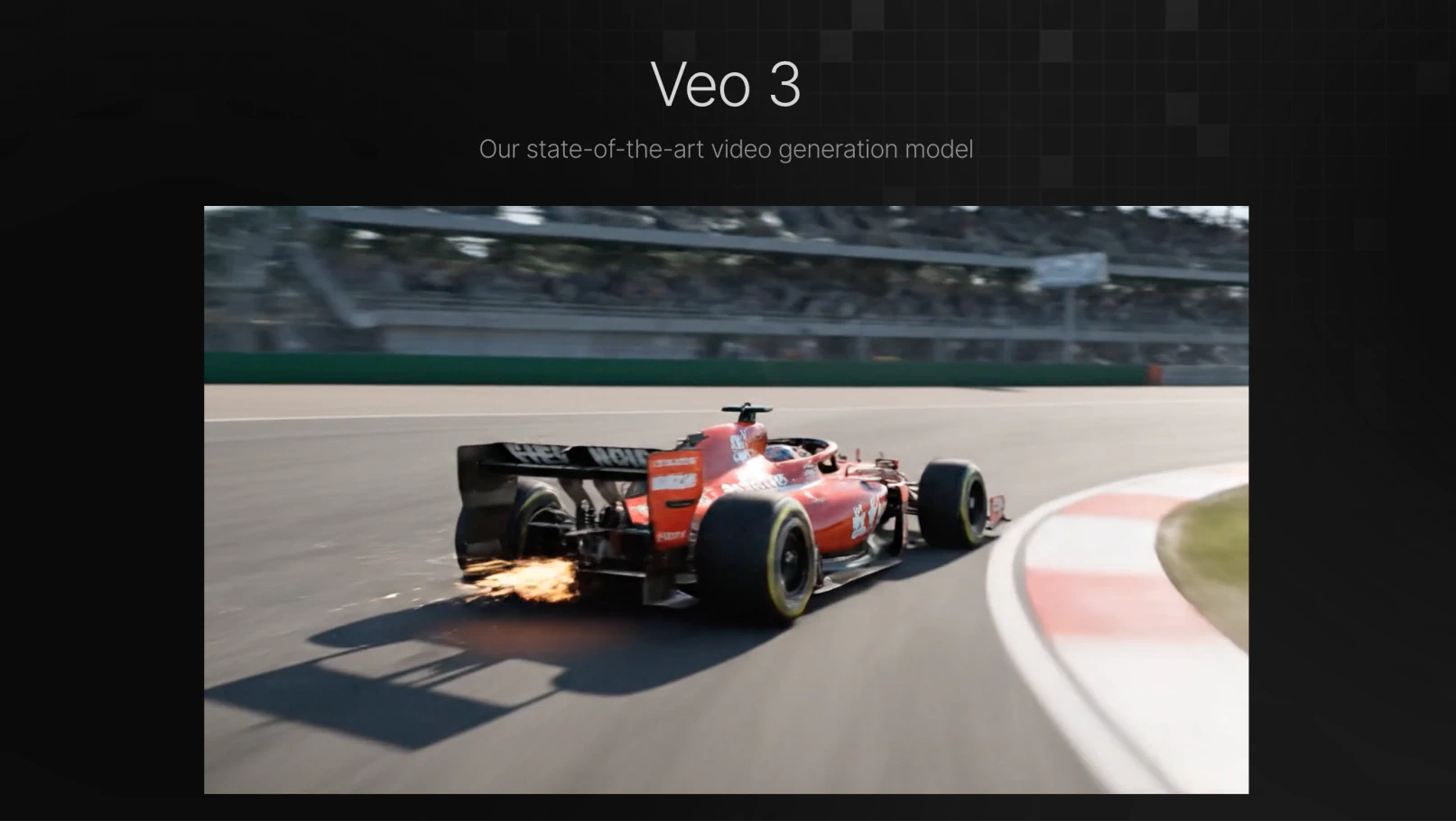
Google Veo 3 is DeepMind’s latest AI video generator, designed to produce highly realistic, cinematic AI video with fluid camera motion, detailed environments, and synchronized sound. Veo 3 combines latent diffusion technology—widely regarded as a leading approach in generative media—with multi-modal outputs, delivering immersive, high-quality video experiences
Capable of producing high-fidelity videos with synchronized sound, dialogue, and realistic motion, it’s accessible to developers via Gemini or APIs.
OpenAI Sora: Language-Aware Video Model
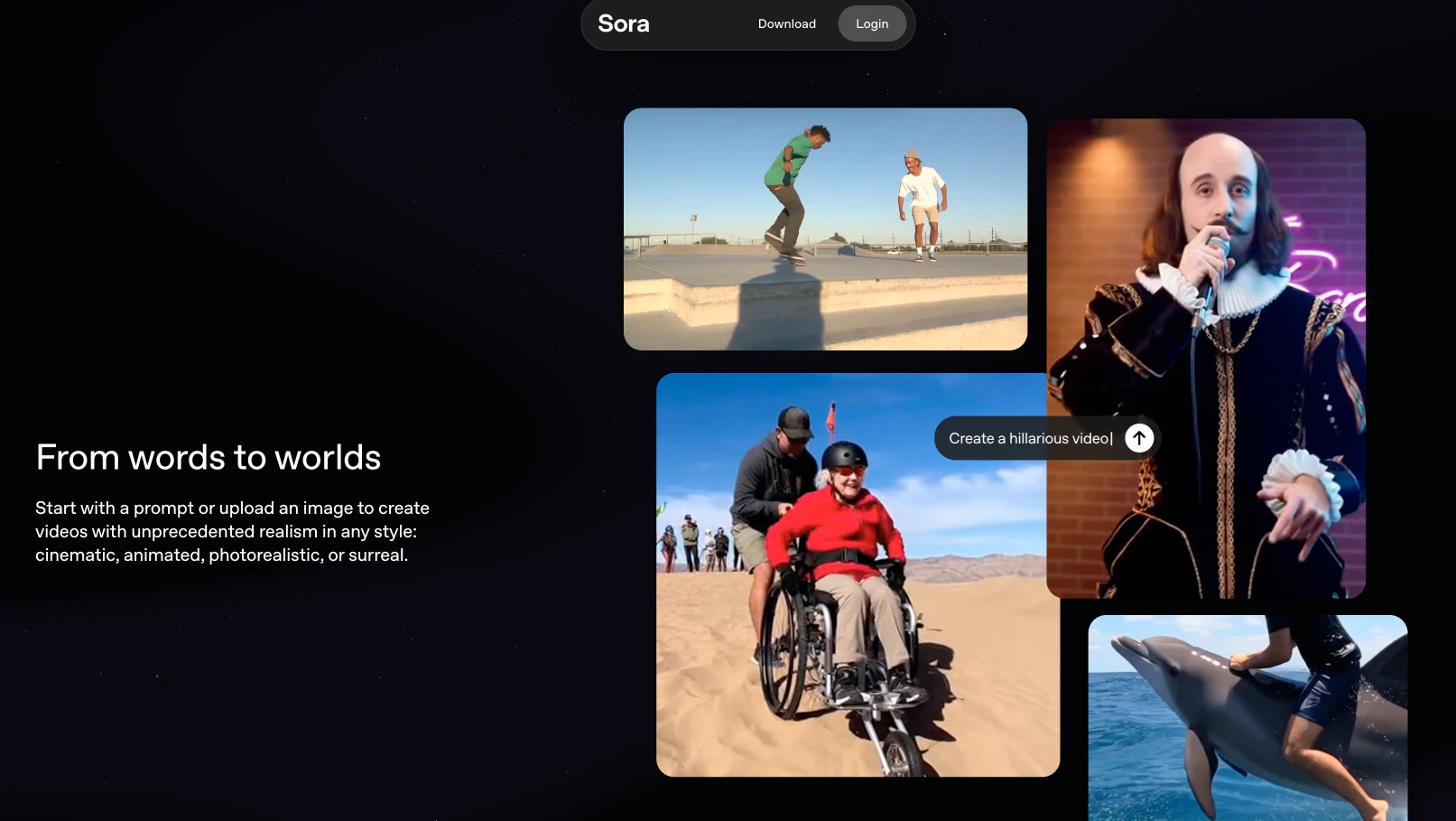
OpenAI Sora is an advanced AI text-to-video system capable of producing multi-shot, story-driven video sequences. Since ChatGPT made Sora publicly available in December 2024, it has been available to ChatGPT Plus and Pro users.
Its editing tools, including Storyboard, Remix, Loop, and Blend, give users more control over both structure and style. Unlike other engines, Sora is proprietary to OpenAI and only available through the ChatGPT ecosystem.
The Future of AI in Filmmaking
As AI advances, filmmakers have access to powerful software platforms like LTX Studio, Runway, Moonvalley, and Pika Labs—each built on top of cutting-edge AI video models like LTXV, Google Veo 3, and OpenAI Sora.
For professionals in film, advertising, content creation, and marketing, the takeaway is clear: embracing these tools now means building AI-friendly workflows that combine human creativity with AI efficiency. In a world that’s changing every second, this is how professional creatives will stay ahead in a rapidly evolving industry.
Related posts

Best Filmmaking Software FAQs
What is the best AI filmmaking software for script-to-screen production?
LTX Studio is the best AI filmmaking platform for script-to-screen production, combining writing, storyboarding, shot planning, and cinematic visualization in one environment. It supports multiple AI models including LTX-2 with synchronized audio and video generation, cutting iteration time significantly for filmmakers, agencies, and production companies.
What are the best screenwriting software options for filmmakers?
Final Draft is the industry standard with studio-approved formatting and revision tracking. LTX Studio integrates scriptwriting directly with storyboarding for visual development. Celtx combines screenwriting with pre-production planning including budgets and schedules, while WriterDuet excels at real-time collaboration for remote teams.
What AI video models are shaping the future of filmmaking?
Key AI video models include LTX-2 (the engine behind LTX Studio) offering frame-level control with three performance modes for speed and quality, Google Veo 3 producing cinematic video with synchronized sound, and OpenAI Sora creating multi-shot story-driven sequences with advanced editing tools available through ChatGPT.