- Short film scripts require precision and economy, with the "1 page = 1 minute" rule applying to runtime (5-page script = 5-minute film)
- Effective short scripts focus on one protagonist, limited locations, and a single emotional beat or turning point following Setup-Conflict-Resolution structure
- Visual storytelling matters more than dialogue in short films—show character, mood, and plot through actions, not exposition
- LTX Studio's script-to-video tools enable visualizing your short film script before production, testing pacing and narrative flow through storyboards
With the advent of visual-first storytelling platforms like Instagram and TikTok, the concept of a "short film" continues to evolve. Whether you're an aspiring filmmaker, an independent filmmaker, or a screenwriting student, writing a short film script can help you hone your storytelling skills and showcase your talent.
Learning how to start writing a script for a short film requires precision, structure, and creativity. Unlike feature-length screenplays, short movies need to captivate the audience quickly while delivering an impactful narrative.
Tools like LTX Studio's script-to-video feature simplify the process by helping filmmakers visualize and refine ideas from script to screen.
This blog will walk you through everything you need to know, from understanding the format of a short film to actionable tips for creating your script. Along the way, we'll explore story length, structure, and the importance of visual storytelling.
By the end, you'll be ready to craft a short film script that stands out in a highly saturated industry.
What is a Short Film?
The beauty of short films lies in their ability to explore ideas, perspectives, and unique filmmaking techniques without the constraints of a full-length production. Since fewer resources are typically required, they are an outlet for filmmakers to showcase their creativity and vision.
Short films are often used by filmmakers to:
- Showcase directorial or storytelling talent
- Pitch larger concepts to investors or studios as proof of concept
- Experiment with creative ideas on a smaller, cost-effective scale
- Launch careers or land representation through festival screenings
Before jumping into how to write a short film script, it's important to know what defines a short film.

How Long is a Short Film?
The Academy of Motion Picture Arts and Sciences defines a short film as any scripted motion picture under 40 minutes. Its format includes all the elements of traditional storytelling, but delivered in a highly condensed manner. This requires clarity, focus, and narrative precision.
Festival rules vary: Sundance allows up to 50 minutes, while the Academy sets the limit at 40 minutes. However, most short film festivals prioritize shorter runtimes to fit more entries into programming blocks. A five-minute short takes up far less screen time than a 40-minute one, increasing your chances of selection.
If you're asking yourself, "how long should a short film be," consider both creative goals and practical distribution strategies.
Short films vary significantly in runtime and narrative structure. Here's how different lengths shape the storytelling style:
| Runtime | Page Count | Structure | Best For |
|---|---|---|---|
| 1 to 2 minutes | 1 to 2 pages | Single moment or idea | Social media and concept proof |
| 5 minutes | 5 pages | Basic setup conflict resolution | Festival shorts and calling cards |
| 10 minutes | 10 pages | Full three act structure | Character exploration and narrative depth |
| 15 to 20 minutes | 15 to 20 pages | Extended character arcs | Ambitious festival submissions |
| 30 to 40 minutes | 30 to 40 pages | Near feature length complexity | Rare and limited festival acceptance |
Screenwriters often follow the "1 page = 1 minute of runtime" rule when drafting scripts. A 2-minute short film script should be roughly 2 pages, whereas a 5-minute short film would require approximately a 5-page script, and a 10-minute short film could fit a standard three-act structure.
Knowing the optimal length based on your story's complexity is crucial, especially if you're aiming for big-name festivals, where runtimes of under 10 minutes are usually preferred for shorts programming.
Learning from Short Film Script Examples
Perfecting story structure is a lifelong journey, but one of the best ways to strengthen your understanding of story is by reading scripts and screenplays, which can be found on go-to resources like the Internet Movie Screenplay Database and The Black List.
If you're looking for unproduced example scripts for short films, try exploring resources like Simply Scripts, which showcases original, copyrighted work.
How to Start Writing a Script for a Short Film
Starting can be the hardest part of the writing process. Unlike feature-length stories, short films demand clarity of concept and economy of expression. The goal isn't to compress a big idea into fewer pages. It's to find an idea that is perfectly sized for the format you choose.
Here are some foundational steps to help you begin:
Define a Focused Concept, Not Just a Premise
A compelling short film starts with a clear dramatic question, something emotionally or thematically rich that can be resolved in just a few minutes. Ask yourself:
- Who is the story about?
- What does the character want (objective), and who or what is preventing them from getting it (conflict)?
- Why does this moment or story matter now?
The protagonist wants something. That's the beginning. They try to get it but it's really hard. That's the middle. In the end they succeed or fail, having experienced some kind of change. That's the end.
Beginning, middle, and end. This simple framework applies whether you're writing one page or thirty.
Explore Through Visual Language
Short films are about showing, not telling. Let images, actions, and moments carry meaning. Use visual tools to explore questions like:
- What does the emotional arc look like?
- Can the story unfold in just a few locations?
- What is the tone and style of this short?
Film is a visual medium. Instead of relying on dialogue to explain your story, think about how you can show emotions, plot, and character development through visuals: actions, settings, facial expressions, and body language.
Keep It Scalable and Contained
The best short films feel complete, even though they're small in scope. That means limiting the number of characters, locations, and plot points while making sure the arc resonates as a payoff for your reader.
Here are a few creative constraints to consider:
- Stick to one protagonist
- Choose one primary location, if possible
- Focus on one emotional beat or turning point
These limitations can actually make your film stronger by sharpening focus and removing distractions. Limits force creativity. Instead of overwhelming notion that your film can be about anything in the entire universe, you can look to places, things, and people around you for inspiration.
Visualize Before You Write
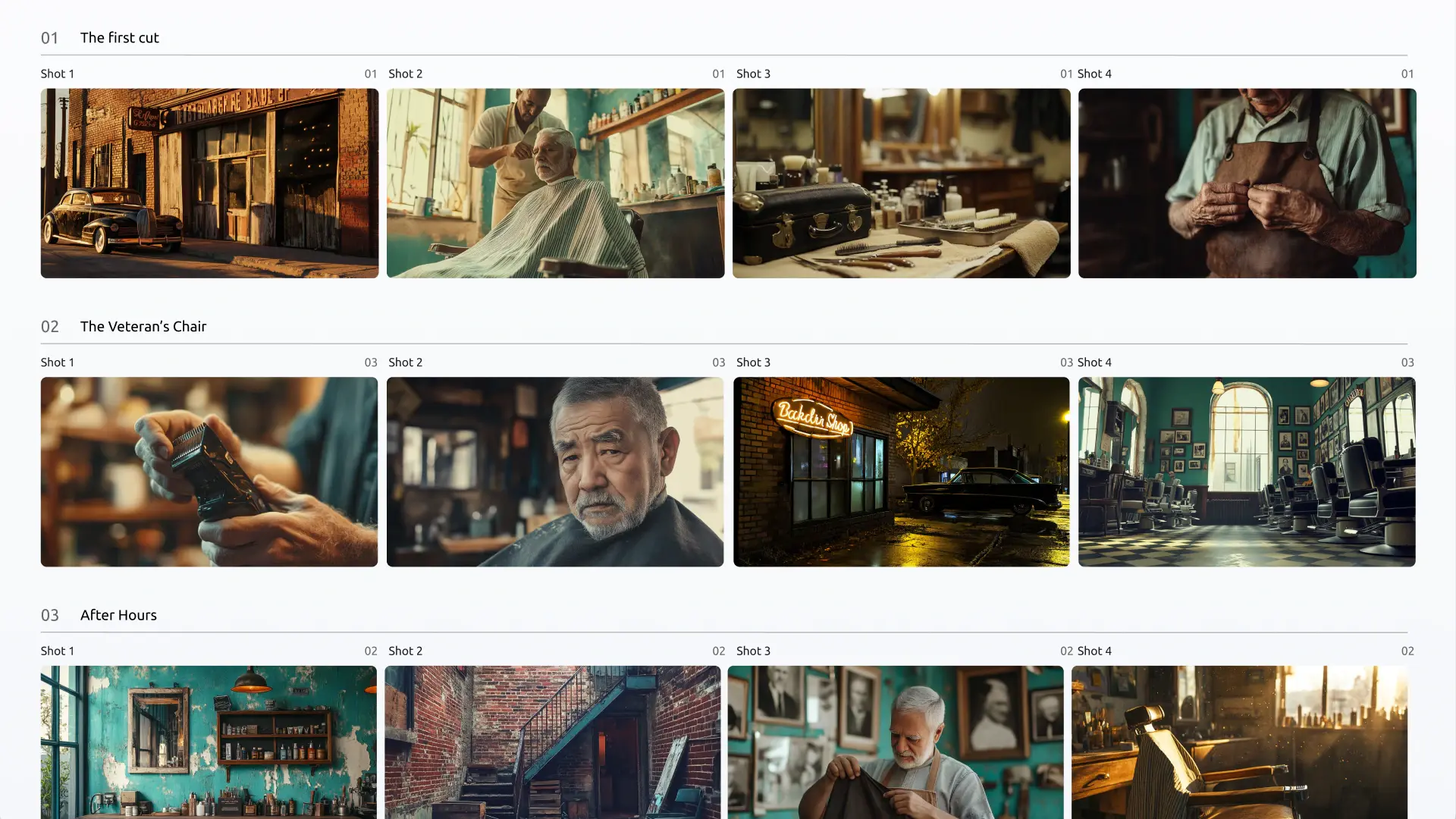
LTX Studio's tools can help streamline this early creative development stage by turning your text prompts into visual, AI-generated scenes. This allows you to test variations of tone, structure, and pacing before you commit to any creative decisions.
Tools like storyboard view, motion generator, and timeline enable you to quickly iterate on your ideas so you can identify what's working and what needs adjusting before you ever step on set.
The power to visualize your film early means avoiding rewrites or misaligned production decisions later.
How to Write a Great Script for a Short Film
Once you've nailed your idea, it's time to bring it to life. The process of writing a short film involves careful attention to structure, formatting, and storytelling techniques.
Stick to Simple Structure
The most effective short films follow a simple, tried-and-true structure:
Setup
Introduce the characters and setting. Since this is a short film, you don't have a lot of time to get things going. Quickly meet your protagonist, get a sense of what they want, and establish what the problem is.
The inciting incident should occur on page one of your short film script. There's no time for extended setup in shorts.
Conflict
The main challenge or turning point. Your protagonist tries to get what they want but faces obstacles. This obstacle might be another person (antagonist), something physical, an animal, society, or even the protagonist themselves.
Whatever the obstacle, make sure your protagonist really wants their goal. If they don't care, your story will fizzle out.
Resolution
Wrap up the story meaningfully. The protagonist succeeds or fails, having experienced some kind of change. The resolution might not be happy, but it should be earned.
For example, a 3-minute short film script can work within this model, allowing just enough room to hit the beginning, middle, and ending beats.
Show, Don't Tell
Focus on telling your story through action. Use storyboards, like those available in LTX Studio, to visualize key moments and ensure every frame is driving the story forward.
Visual storytelling is essential in a limited runtime, so using tools available on LTX Studio make it easy to storyboard a short film, helping you align pacing, tone, and narrative flow visually from the start.
Use location as a character
The way characters interact with the environment should give the reader information about their emotional state, backstory, or current problem. A cluttered apartment, a locked door, or an empty fridge speaks volumes.
Trim the fluff
Start action at the moment of tension and cut out before the resolution is spelled out. A good rule of thumb when writing the script for a short film is to "enter late, and get out early." Enter each scene as late in the action as you possibly can, and exit as soon as your character has gotten what they need from that moment.
Use storyboards to test ideas visually
LTX Studio lets you preview how visuals and pacing translate visually. Use these tools to sharpen your story before committing to production.
Craft Engaging Dialogue
Dialogue in a short film should be sharp and efficient. It must feel natural but deliberate, propelling the narrative forward while revealing character desires, relationships, and motivations.
Here are a few tips on how to craft engaging dialogue in a short film script:
Dialogue should move the story forward
If it doesn't advance plot, reveal character, or create conflict, it's not needed. Every line must earn its place.
Speak in character, not exposition
Dialogue should reflect who the character is, not explain what the audience needs to know. Characters don't announce their feelings or backstory. They speak as real people do, with subtext and intention.
Conflict belongs in conversation
Even quiet scenes benefit from friction. Exchanges where each character wants something different heighten the stakes and immediately make the content more engaging.
Keep it concise
Short films work best with lean, purposeful exchanges. Extended conversations eat precious runtime. Make every word count.
Format Properly
Professional screenplay formatting isn't just about appearances. It ensures that everyone involved, from actors to directors, can easily interpret your work.
Standard screenplay formatting includes:
- Scene headings: INT. or EXT., location, time of day (all caps)
- Action lines: Present tense, concise descriptions of what's happening
- Character names: All caps, centered above dialogue
- Dialogue: Indented beneath character names, no quotation marks
- Parentheticals: Brief acting instructions (use sparingly)
- Transitions: Optional (CUT TO:, FADE OUT) unless needed for emphasis
Professional screenplay software handles technical details automatically. Consider tools like Final Draft, WriterDuet, or Celtx. These programs format correctly with proper margins, spacing, and font (Courier, 12-point).
From Script to Screen: Key Elements and Tips for Success
Your script is the roadmap for production. With proper planning and the right tools, translating this so you know how to film a short movie becomes far more manageable and efficient.
Pre-Production Planning
Casting & Locations
Your script informs character needs and ideal settings. Limit both to what's realistically achievable within your budget and resources.
Budget
Simplify scenes to lower costs. Fewer locations often reduce expenses dramatically. Contained stories with minimal cast keep production manageable.
Visual Tone
Use your script to guide decisions around color grading, set design, and shot composition. Establish visual style early so all departments work toward the same aesthetic.
Script to Video with LTX Studio

Platforms like LTX Studio streamline the entire transition from page to screen. Here's how:
- Upload your finalized script to the platform
- Transform it into a scene-by-scene storyboard, complete with visual structure and notes
- Experiment with camera angles, lighting, locations, character designs, and transitions
- Visualize your short film with AI-powered tools before production begins
- Generate sample footage that demonstrates your creative vision
- Export storyboards or pitch decks for presentations
If you're wondering how to storyboard a short film, LTX Studio offers intuitive tools to help you go from script to shot list, making it easier to visualize, refine, and communicate your vision clearly.
These features are invaluable for refining ideas and iterating quickly, ultimately saving time and money during production.
Testing Narrative Flow Before Filming
Traditional scriptwriting means committing to creative decisions without seeing how they'll play on screen. You write the script, hope it works, then discover problems during production when they're expensive to fix.
LTX Studio inverts this process. Upload your script and immediately see how scenes flow together, whether pacing feels right, if transitions work smoothly, and how editing techniques will shape the final experience.
This preview capability catches problems during writing rather than during production. Adjust pacing in the script stage. Refine transitions before filming. Test different structural approaches risk-free.
Telling a Complete Story with a Short Film
A well-crafted short film script is the foundation for a fully realized narrative. By focusing on structure, visual storytelling, and efficient dialogue, you give your project the clarity and momentum it needs to stand out.
And with tools like LTX Studio, you can go from concept to storyboard to final visuals faster and more confidently than ever before.
The Power of Constraint
Short films demand discipline. Every scene must earn its place. Every line of dialogue must serve multiple purposes. Every character must contribute meaningfully to the narrative.
These constraints aren't limitations. They're creative advantages. When you can't rely on sprawling runtime to develop ideas gradually, you're forced to find the most powerful, direct way to tell your story.
The result is often sharper, more focused storytelling than longer formats allow.
Why Short Films Matter
Short films serve as calling cards demonstrating your creative voice, proof of concept for larger projects, festival entries that can launch careers, and portfolio pieces that secure representation or funding.
Many celebrated filmmakers started with shorts. Damien Chazelle's Whiplash began as an 18-minute short that secured funding for the feature. Andrea Arnold's Wasp won the Oscar and led to feature directing opportunities. Taika Waititi's early shorts demonstrated the distinctive voice that would define his later work.
Whether you're creating a 1-minute short film script for TikTok or a 10-minute narrative piece to submit to film festivals, remember: clarity, focus, and intent are your best assets. Let each decision serve your story.
Ready to transform your short film script into visual reality? Start creating with LTX Studio's AI movie maker and experience how AI-powered visualization helps you refine scripts before production begins.
Related posts

Short Film Script FAQs
How long should a short film script be?
The Academy defines short films as under 40 minutes, with scripts following the "1 page equals 1 minute" rule. A 5-minute short film requires roughly a 5-page script, while 10-minute scripts allow for traditional three-act structure. Film festivals typically prefer shorts under 10 minutes for programming.
What's the best structure for writing a short film script?
The most effective short films follow simple structure: Setup (introduce characters and setting), Conflict (main challenge or turning point), and Resolution (meaningful wrap-up). Focus on one protagonist, one primary location if possible, and one emotional beat or turning point to keep the narrative sharp and focused.
How do you write a short film script with visual storytelling?
Focus on showing rather than telling through action—use location as a character, trim unnecessary dialogue by starting at moments of tension, and leverage tools like LTX Studio's storyboard features to test ideas visually. Dialogue should move the story forward, reflect character voice, and include conflict in conversations to heighten stakes.